
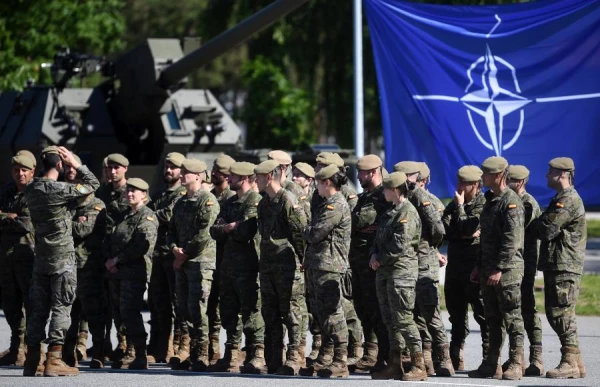
Americans traditionally play a leading role in NATO. Currently, high-level discussions are underway about changing this status in the future. Is German leadership in the alliance possible?
The U.S. has expressed a desire for Germany to take command of NATO forces in Europe. This was stated by the U.S. Permanent Representative to NATO, Matthew Whitaker, at the Berlin Security Conference.
"I look forward to the day when a representative from Germany comes to the U.S. and says that Germany is ready to take on the role of Supreme Allied Commander Europe (SACEUR)," Whitaker said. Although he acknowledged that "we are still far from that," he is nonetheless eager for those discussions, reports the British Telegraph.
According to Whitaker, the U.S. wants European military forces to be on par with the U.S. He called this an "ambitious goal that everyone should strive for."
A source in the U.S. familiar with the situation told Euronews that Whitaker is "a person who adheres to traditional American views on NATO," which is why his statement came as a surprise. However, "the Trump administration hinted at this several months ago."
Another source in NATO told Euronews that "Whitaker's comments align with American statements that the security of Europe is in the hands of Europeans."
A representative from the defense ministry of one NATO country stated that they do not see "how and why" the U.S. could relinquish SACEUR, as it is vital for U.S. interests and global influence. However, the source noted that the U.S. is undoubtedly stepping back from European security.
"A withdrawal from SACEUR would be practically very difficult," the interlocutor added.
Risks of Premature Troop Withdrawal Amid the War in Ukraine
The recently published 28-point peace plan by the U.S. and Russia, outlining the conditions for ending the war in Ukraine, has been perceived as yet another sign that Washington may be looking to gradually relinquish its leadership role in NATO in the long term.
Speaking to a German television channel, security expert Dr. Claudia Major described this plan as "de-Americanization of NATO," noting that it presents the U.S. not so much as an active member of the alliance but rather as a mediator between NATO and Russia.
Meeting of the "Group of Five": Germany to Purchase American Weapons for Ukraine
A source from the U.S. told Euronews that "philosophically, it is hard to argue with this," as "it may make sense" in the long term. At the same time, the source warned that, given the "instability" and "madness" of the war in Ukraine, now is not the right time for Americans to exit NATO.
According to security expert Professor Carlo Masala from the Bundeswehr University Munich, this is linked to the Americans' desire to "gradually step back from the role of leader."
"First and foremost, it is important to note that this statement was forward-looking and did not imply that Germany should take over command tomorrow, but rather in a longer-term perspective," Masala said in an interview with Euronews.
German SACEUR
Traditionally, since the founding of the alliance, the role of Supreme Allied Commander Europe (SACEUR) has been held by an American general or admiral. However, this is not enshrined in directive or law - rather, it is considered a political and historical agreement.
Currently, the position of Supreme Allied Commander of the Allied Forces in Europe is held by U.S. Air Force General Alexis G. Grinkevich. He also leads the U.S. European Command.
According to Masala, a German - or, more broadly, European - SACEUR will no longer command American troops.
Currently, the U.S. European Command reports approximately 78,000 American military personnel stationed in Europe. Last month, the number of American troops in Romania was reduced from 4,000 to about 1,000.
Plans to reduce American troops in Europe date back to Trump's first presidential term. "Strangely enough, the number of troops permanently stationed in Germany actually increased at that time," explained U.S. Army officer and former commander of American forces in Europe Ben Hodges in an interview with Euronews.
Now, "the administration seems more determined to make cuts," Hodges added. According to him, what the U.S. currently has in Europe (the number of American military) is not needed in the Pacific region, but it can still be reduced to free up money and resources.
Germany as the Engine of Europe's Rearmament
After Russia's invasion of Ukraine in 2022, and Trump's return to power, Europe developed a rearmament plan. Future defense spending exceeding one percent of Germany's gross domestic product (GDP) will not be subject to debt limits, and from January 2026, young people will again be subject to conscription.
Masala believes that Germany is currently the only country in Europe capable of promoting "all this rearmament policy" due to its financial resources.
"One way or another, we are entering a new military-political role," said the security expert, acknowledging, however, that Berlin "has not fully realized this yet."
According to Euronews, such a scenario is currently not being discussed in NATO. "We are not discussing how this will work because it simply does not matter," the statement said.
However, according to Masala, a German SACEUR would not help in the Europeanization of NATO, "because all this management function that NATO performs regarding European armed forces is primarily carried out by the Americans."
"In other words, simply replacing someone at the top will not help if the Americans are indeed gradually stepping back from NATO, including regarding their personnel," Masala adds. There will still be a need for a country that can replace the U.S. In his opinion, only the United Kingdom and Germany will remain.
"However, ultimately, it can be said that this statement - this desire - is a kind of look into the future. The Americans will reduce their involvement - I think this should be expected," the expert believes.
A complete withdrawal of the U.S. from NATO is not expected, as Euronews learned from sources in the Lithuanian Ministry of Defense. The U.S. will still need its global influence, they note. Nevertheless, pressure on Europe to step up its defense efforts remains.










Leave a comment