

The article presents general rules and tips for floor cleaning, as well as recommendations for washing various types of surfaces.
Many housewives do not think about how to properly clean floors, although this is an important aspect for maintaining hygiene and the appearance of the apartment.
General Principles
How often should floors be cleaned? It is recommended to clean at least once a week, paying attention to areas under carpets, unless there are special reasons to do it more often. However, if there are small children or pets in the house, it is better to clean the floors two to three times a week or even daily.
If cleaning seems exhausting, and the area of the apartment does not allow for daily cleaning, here are some useful recommendations:
* For easily washable surfaces, disposable universal wet wipes can be used. This will save time and effort, as there will be no need to rinse the mop frequently, making cleaning more effective.
* First, dust other surfaces, as most of the debris accumulates on windowsills, tables, and furniture.
* Before washing, go over the surface with a vacuum cleaner or broom to remove large debris and avoid double work.
* Don't forget about the baseboards, which accumulate a lot of dust. This will make cleaning more effective.
* If daily floor washing is not possible, focus on the most soiled areas, such as the hallway and kitchen.
Try to clean small stains, for example, in the kitchen, immediately rather than waiting for the scheduled cleaning.
How to Clean Tile, Laminate, and Linoleum
These surfaces are popular because they are stain-resistant and do not require special care.
For regular cleaning, clean water is usually used, changing it several times, and for deep cleaning, special detergents are added.
To wash tile without streaks, use only a clean cloth and thoroughly rinse the detergent, changing the water several times. Effective helpers for shine are ammonia and vinegar essence, as well as citric acid, which can be used for both local stains and general floor washing by diluting a couple of tablespoons of the agent in a bucket of water.
For marble floors, the same recommendations apply. Special products in the form of sprays and gels are most often used for cleaning. To keep the floors in their original condition, wax can be used to create a protective film and dirt-repellent compositions.
Stains on marble can be removed with a homemade bleach by mixing ammonia and hydrogen peroxide in equal proportions. Apply the mixture to the stained area, leave it for a day, then remove the residue and wash the floor as usual. Greasy stains can be removed by applying starch and leaving it for a few hours.
Laminate flooring should be cleaned carefully. The washing time and amount of water should be minimal to prevent the laminate from "swelling." Move parallel to the seams to minimize moisture getting on them.
Use a soft microfiber cloth. During deep cleaning, first wash with a detergent, and then a second time with plain water. As an alternative to store-bought products, you can add 150 ml of white vinegar to a bucket of water (about 10 liters).
For linoleum, choose soft fabric wipes to avoid damaging the surface. In the absence of heavy soiling, it is sufficient to wash the floor with clean water. For removing stains, you can use a solution: add a couple of tablespoons of liquid soap and 150 ml of vodka to two liters of water.
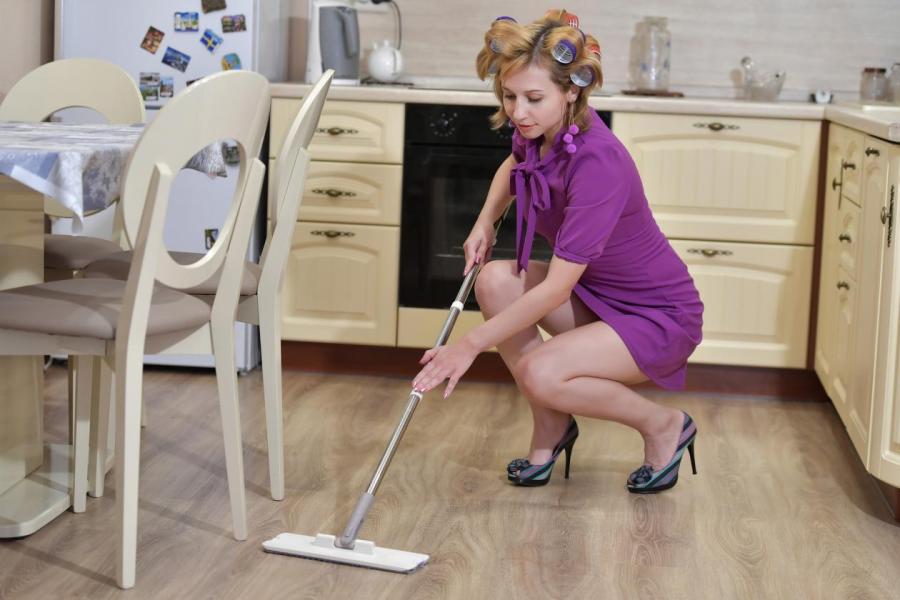
How to Clean Wooden Floors
If the floors are wooden, avoid using large amounts of water to prevent them from swelling. Regardless of whether the floor is lacquered, the cloth should be well wrung out before cleaning.
For parquet floors, use the following recipes:
* In warm water, dilute ammonia or vinegar at a ratio of one tablespoon per liter of water. To avoid streaks, do not lift the mop from the surface too often; it is better to move in an "eight" shape.
* Rubbing the surface with linseed oil will give it shine. You can also use a polish or solution: dilute 50–70 ml of vinegar, 1–2 tablespoons of polish, and 2 liters of water.
* Unpainted and unvarnished wood can be washed with water mixed with a small amount of soap or powder. Alkali is also suitable: add 2–3 tablespoons of soda to a liter of warm water and wipe the surface with a brush or sponge.
Black streaks can be removed with a dry canvas cloth. If they have set in, baking soda will help: apply a little to the cloth and rub the stain, then rinse with water.
Sticky stains, such as glue or chewing gum, can be removed by applying an ice pack to them. When the stain freezes, remove it with a spatula. To remove paint, use cotton wool soaked in alcohol.
How to Clean Cork Floors
Cork floors require careful maintenance. The appearance of stains requires immediate cleaning.
Use special soft products that are soluble in water. Clean cork floors with a soft-fiber cloth or sponge, avoiding stiff brushes. The cloth should be well wrung out to avoid excess moisture. Sometimes, a little laundry detergent is diluted in water to clean an unvarnished surface. After cleaning, the surface should be dried to avoid swelling.
After washing the cork surface, you can "refresh" it by wiping it with a cloth soaked in a solution: dilute a couple of tablespoons of vinegar in 5–6 liters of water.
To ensure that the floors last longer and look like new, familiarize yourself with the care recommendations and follow them.















Leave a comment