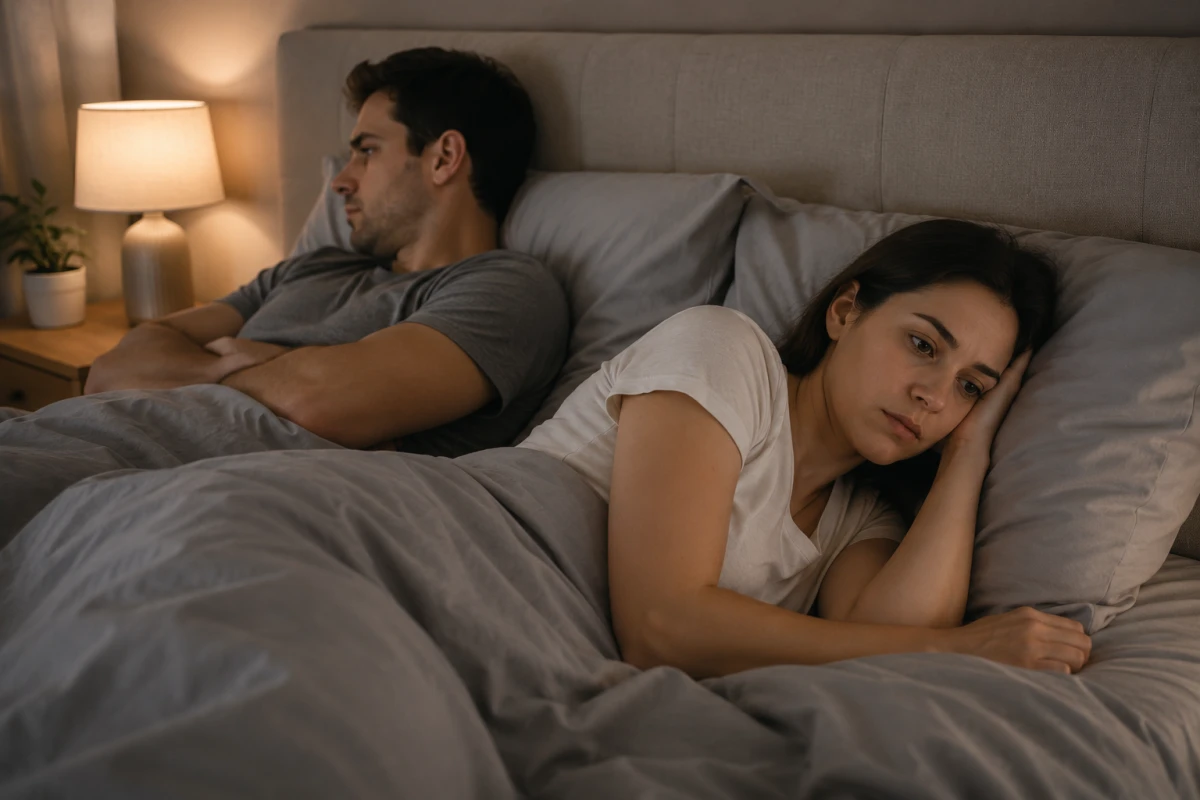
A decrease in sexual desire is not always related solely to hormones or relationship problems. According to specialists, libido can be influenced by stress, chronic fatigue, vitamin deficiencies, health issues, and even emotional burnout.
Most people face a loss of sexual desire unnoticed. Everything seems fine: life goes on, there is work, and relationships are also present. Yet, there is no desire for intimacy with a partner.
It’s not that "I don’t feel like it right now," but rather that it seems to have become irrelevant overall. At the moment of realization, an internal dialogue begins; a person searches for the problem within themselves, in their partner, or in the relationship.
There are two pieces of news. The good one: if you don’t want sex for a couple of days or even a couple of weeks — that’s normal. Libido doesn’t operate on a schedule like an alarm clock. The bad one: if the desire has seriously and long-term disappeared — the reason is almost always not singular. And figuring it out will be difficult.
Interestingly! There is a popular myth: if something is wrong with libido — it’s due to hormones.
In practice, it’s more complicated. Libido is like a general indicator of the body’s condition. It’s somewhat like an internal "everything is fine/everything is bad". If you’ve had enough sleep, are not stressed, and feel normal — it exists. If the body is in "holding on as best as we can" mode — it disappears first. "A decrease in libido is almost always multifactorial. That is, it’s not ‘one cause — one result,’ but a whole set: a bit of fatigue, a bit of stress, a bit of sleep deprivation — and suddenly there’s no time for romance," explains gynecologist Nina Antipova.
When the Body is Not in the Game: A Problem at the Physiological Level
Sometimes everything is quite prosaic. The body simply lacks resources — and honestly communicates this. The main reasons why desire disappears:
Iron at zero — energy goes down with it. If there is a hidden iron deficiency, you may feel like your battery is running low by lunchtime. In such a state, the body focuses on basic tasks: survive, get home, not forget the keys. Sex is very far down that list.
Vitamin D and the "winter hibernation mode." Its deficiency often gives a feeling of overall lethargy. Not dramatically, but consistently: there’s no tone, no mood, no desire. In cases of deficiency, drowsiness and even apathy prevail.
Thyroid that "slows everything down." If it’s not functioning as it should, processes in the body slow down too. And yes, libido is also affected. The problem is often resolved with proper nutrition, but sometimes medication is necessary.
Hormonal fluctuations. This is not about the hormones themselves, but about the body’s reaction to hormonal contraceptives. Most women tolerate them well. However, for some, they can change subjective sensations: everything seems fine, but the "spark" is gone. This doesn’t happen all the time, but it can occur.
"If pain often arises during intimacy, dryness is noticeable, or any unpleasant sensations occur — the body will not ignore this for the sake of desire. Libido disappears simply out of fear of bad sensations," warns the doctor.
When It’s in the Head (and a Bit in Life)
There are far more psychological reasons for a decrease or complete absence of desire for intimacy than physical ones. Let’s consider the main ones:
Accumulated fatigue. The body has entered that mode where you just want to lie down and not be disturbed. In such a state, libido is the first victim. Until the body rests and recovers, the problem won’t go away.
Constant stress. When tension becomes a background state, the body doesn’t switch to relaxation, which is necessary for desire to arise. Simply put, if you are always "on alert," there’s no room for spontaneity and pleasure.
Relationships with accumulated tension. Libido rarely exists separately from emotions. If there are grievances, unspoken words, irritation, or a feeling that you are not being heard in a relationship, it inevitably affects intimacy.
Familiarity without novelty. If the entire intimate aspect of the relationship turns into a repetitive scenario without changes, the brain stops perceiving it as something stimulating. This is not about a "boring partner," but about the psyche needing variability. Without it, interest decreases, and along with it, desire.
Uncomfortable self-perception. If there is constant dissatisfaction with appearance, body, or condition — it affects the level of confidence and relaxation. Internal monitoring arises: how do I look, how do I behave, what will they think. In such a state, it’s difficult to switch to pleasure because attention is directed not at the process but at self-observation. And the stronger this tension, the weaker the desire manifests.
"Regardless of the reason for the lack of desire, its absence becomes a problem in relationships. Because the partner doesn’t always understand what’s happening. Often, it’s perceived as ‘I’m no longer interesting.’ Or worse — ‘she has someone else.’ To avoid exacerbating the problem, just talk. Explain your state, and a loving person will always support you," assures Antipova.
Can Libido Be Restored?
For men, desire is often tied to physical condition: energy, hormones, overall well-being. For women, context plays a stronger role: emotions, atmosphere, internal feeling. But to restore sexual activity, both need to:
Restore resources. Regular sleep, a normal daily routine, and at least minimal breaks from constant work throughout the week have a much greater effect.
Check physical condition. If there are suspicions of deficiencies (iron, vitamin D, B12), thyroid problems, or pronounced fatigue — it makes sense to get tested.
Improve relationships. If there are grievances against the partner or accumulated irritation, desire rarely returns on its own. In this case, a normal conversation and restoring contact help.
Reconnect with your body. Sports, movement, any activities that provide contact with the body and a feeling of "I’m in resource" gradually influence the level of desire.
And remember that libido does not return on its own if the reasons for its disappearance are ignored. The most effective way to restore activity is to improve overall condition. In most cases, this is what yields results.
Experts remind us: a temporary decrease in libido is normal, but if the problem persists, it’s important to look for not just one reason but to consider the overall condition of the body and psyche. Full sleep, stress reduction, health care, and an open conversation with a partner often help restore desire and emotional closeness, writes bb.lv.