Elevated blood pressure needs to be treated. A doctor can prescribe not only medication but also provide recommendations for lifestyle changes. These should be followed; otherwise, you risk developing complications.
In arterial hypertension, blood exerts pressure on the walls of blood vessels more forcefully than it should under normal conditions. This condition forces the heart to work under overload, which can lead to serious health problems.
In hypertension, blood vessels are constantly under increased pressure. As a result, their walls may thicken, lose elasticity, and become damaged. Under such conditions, the heart is forced to work harder, which sooner or later leads to its overstrain.
If hypertension is not treated, it can lead to various complications, not only related to the cardiovascular system.
"Hypertension is not just high blood pressure, but a systemic condition that affects blood vessels and target organs for years. Most problems in hypertensive patients do not arise suddenly, but as a logical consequence of prolonged vascular overload," explains therapist Alexander Novikov.
The systems that suffer the most are those that depend heavily on quality blood supply:
-
heart,
-
brain,
-
kidneys.
What Diseases Most Often Develop in Hypertensive Patients
Firstly, the heart is under attack. It works too actively, which inevitably affects its condition. In people who do not treat hypertension, doctors often diagnose atherosclerosis, ischemic heart disease, and heart failure. Consequently, angina and myocardial infarction may develop.
Let’s break down the mechanism of disease development.
Increased pressure injures the inner wall of blood vessels, and against this background, atherosclerosis develops more rapidly: plaques form that narrow the lumen of the arteries.
When plaques form in the blood vessels of the heart, ischemic heart disease occurs, which can manifest as pressing pain behind the sternum during exertion, shortness of breath, or sudden weakness with cold sweat — this is how the body signals angina or an impending heart attack.
The heart, working against high resistance for years, first thickens and then exhausts, leading to chronic heart failure. As a result, swelling of the shins, shortness of breath with usual exertion, and rapid fatigue occur.
Secondly, high blood pressure also damages the blood vessels of the brain; they can either be blocked by a thrombus, resulting in an ischemic stroke, or rupture, leading to hemorrhage. This can be recognized by facial drooping, weakness in the arms, or sudden severe headache.
Thirdly, the excretory system may also be affected in hypertensive patients. The kidneys are another organ with a very fine vascular network, where constantly elevated pressure literally "burns out" small vessels, reducing filtration function, indicated by swelling and changes in urine tests.
Here are the diagnoses that doctors may make.
Hypertensive nephropathy (hypertensive nephropathy). Chronic kidney damage caused by prolonged high blood pressure.
Chronic kidney disease (CKD). Progressive decline in the kidneys' ability to perform their functions. In the early stages, it may be asymptomatic.
Acute kidney failure. Can develop with sudden disruption of blood flow to the kidneys, for example, due to renal vein thrombosis.
Hypertension is a chronic process, and its complications are mostly of the same nature: atherosclerosis cannot be "removed," but it can be stabilized and slowed down; heart failure can be compensated; and kidney damage can be stabilized.
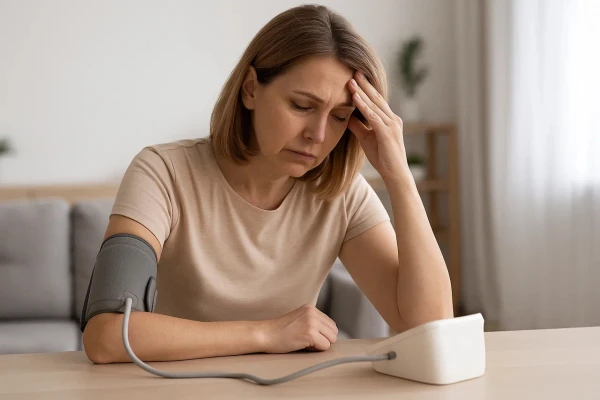
Daily monitoring of blood pressure should become a habit for hypertensive patients, rather than adopting the stance of "I tolerate 150–160, I live like this" — this is a direct path to complications, says Alexander Novikov. If all doctors' recommendations are followed, one can live a long and happy life without blood pressure spikes.
When to Urgently See a Doctor
"High blood pressure provokes damage and hardening of the vascular walls (atherosclerosis), disrupting blood supply and depriving organs of necessary oxygen. Given that elderly people’s blood vessels have already lost their former elasticity and the body's defenses are weakened, the consequences can be devastating," explains gerontologist Anna Shelobanova.
Danger can be recognized by a number of characteristic symptoms. From the nervous system, this often manifests as:
-
headaches in the back of the head,
-
dizziness,
-
darkening of vision,
-
in critical cases — speech disturbances, coordination issues, or numbness on one side of the body.
The cardiovascular system responds to overload with shortness of breath even with light exertion, as well as pain and a pressing sensation in the chest. If one or more symptoms occur, urgent consultation with a doctor is needed.
To protect yourself, regularly measure your blood pressure, trying to keep it in the range of 120–129/80–89 mm Hg. A healthy lifestyle and proper nutrition with limited harmful products, as well as complete cessation of smoking and reduced alcohol consumption, will help health. Don’t forget to monitor your weight and cholesterol levels.
The main thing is to take treatment seriously: take the medications prescribed by your doctor for the full course and do not miss scheduled medical check-ups.