
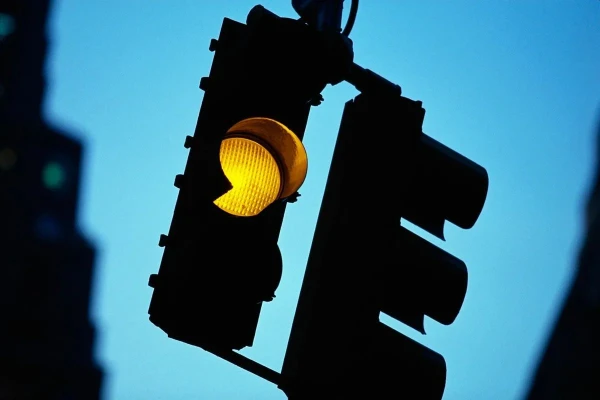
The situation is familiar to everyone: the green signal starts flashing, then the yellow light comes on — and instead of slowing down, the driver sharply accelerates. As a result, the intersection is crossed right at the edge of the prohibitive signal. This behavior seems illogical, but it has quite explainable reasons.
The Illusion of "I Still Have Time"
One of the most common reasons is the subjective feeling that there is still enough time. Drivers tend to underestimate the speed of signal changes and overestimate their own abilities.
Even if it is objectively clear that completing the maneuver safely is not possible, an internal setting activates: "just a little more — and I’ll make it."
Misinterpretation of Signals
Some drivers interpret traffic light signals incorrectly. A brighter and more "active" red color may be perceived as a signal to act, while a calm green may be seen as a neutral background.
Such perceptual features are not directly recognized but can influence behavior behind the wheel.
The Thrill Effect
For some drivers, crossing an intersection on the edge of prohibition turns into a kind of game. The moment of risk is accompanied by an adrenaline rush, and successfully completing the maneuver without consequences reinforces this behavior pattern.
Over time, a habit forms where speeding up at yellow is perceived as a normal reaction.
The Influence of Habits and Experience
If a driver has repeatedly crossed an intersection under similar conditions without fines or accidents, it creates a false sense of security. The behavior becomes ingrained and starts to seem acceptable.
Such "practice without consequences" gradually reduces the critical perception of risk.
Unwillingness to Stop
Sudden braking is perceived as an inconvenience: one has to accelerate again, time is lost, and the rhythm of movement is disrupted. In conditions of haste or heavy traffic, this increases the desire to "squeeze through."
As a result, the decision is made not in favor of safety, but in favor of saving a few seconds.
What the Rules Say
From the perspective of traffic rules, the yellow signal is prohibitive. It allows for the completion of a maneuver if stopping is impossible without emergency braking, but it does not permit entry into the intersection.
Nevertheless, in practice, many drivers ignore this requirement, relying on their own assessment of the situation.
Why It’s Important to Understand
Behavior at a yellow signal is not just a matter of discipline, but a combination of psychology, perception, and habits. Understanding these factors helps better control one’s actions behind the wheel and reduce the risk of dangerous situations on the road.













Leave a comment