
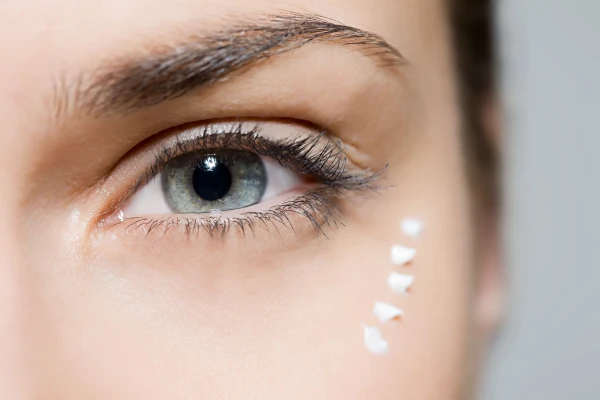
The skin around the eyes ages the fastest, but the reason is not just its thinning. In fact, aging of the eyes is a multi-layered process involving bones, ligaments, and muscles.
Main Factors of Aging in the Eye Area
1. Changes in the Orbital Bones
With age, the bony tissue of the orbit gradually diminishes — resorption occurs. This disrupts the support for soft tissues: the eyebrows droop, the eyes appear sunken, and the face looks tired, even if the skin is in good condition.
2. Connective Tissue
The orbital septum loses elasticity: collagen fibers pull towards the center of the eye, causing the "bag" effect. Puffiness enhances the protrusion of orbital fat, forming bags under the eyes.
3. Ligaments
The orbito-malar ligament becomes stiff and shortened over time. Combined with puffiness, this deforms the lower eyelid and intensifies the appearance of bags.
4. Muscles
The orbicularis oculi muscle works continuously: we blink, squint, and smile. Over time, chronic hypertonicity develops, leading to wrinkles ("crow's feet") and a feeling of heaviness in the eyes. The chewing, temporal, and frontal muscles also affect the shape of the eyes and eyelids: over time, they shorten and become overstrained, creating brow droop, nasolacrimal grooves, and a tendency to puffiness.
Why Simple Skin Lifting Doesn’t Always Help
Surgical methods that only work with the skin do not address deeper issues: bony changes, ligament stiffness, and muscle hypertonicity remain. Sometimes the result looks not rejuvenating but emphasizes age-related changes.
Effective Approach
It makes sense to work with deep structures:
- gently influence ligaments and connective tissue,
- relax muscles and fascia,
- reduce puffiness.
This approach eliminates the causes rather than masking the effects, restoring openness and liveliness to the eyes.
Conclusion: Aging in the eye area is a complex process. Understanding its mechanisms and working with deep tissues allows for a naturally fresh look that lasts long.













Leave a comment