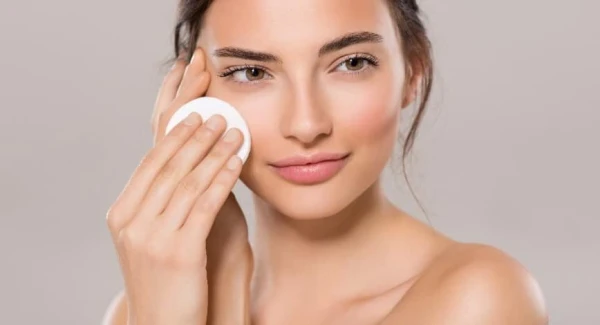
An even tone, hydration, and the absence of rashes are often perceived as unequivocal signs of skin health. However, in practice, dermatologists increasingly encounter a different scenario: externally 'good' skin looks tired, dull, and depleted. Why does this happen, and what signals from the body do we often overlook?
Expert - Anastasia Razbezhkina, dermatologist, cosmetologist.
The Illusion of Well-Being: When Skin is 'Clear' but Depleted
The absence of acne, flaking, or redness does not always indicate health. There is a condition that specialists refer to as 'hidden skin deficiency.' It develops gradually and often goes unnoticed because it is not accompanied by acute symptoms.
This is not a disease or a mistake in care, but a gradual loss of internal resources: moisture, trace elements, and the ability to recover. Visually, the skin may appear 'normal,' but functionally it is working at its limit and therefore responds poorly even to quality care – the effect is either short-lived or completely absent.
Patients often sense this intuitively: 'Everything looks fine in photos, but my face looks tired in the mirror.' Upon examination, the doctor sees good turgor but notes reduced tone, a dull hue, and signs of depletion.
How Skin Looks with Resource Loss
This condition has characteristic but not obvious signs:
-
the skin tone remains even, but a grayish, 'muted' hue appears;
-
there is no pronounced flaking, yet a feeling of dryness persists;
-
fine wrinkles become more noticeable by the end of the day;
-
there is a tendency to swelling, while the skin feels tight and tense;
-
decorative cosmetics apply poorly and quickly lose their appearance;
-
after washing, tightness occurs, and the cream seems to 'disappear,' providing no feeling of comfort.
It is these details that create the impression of a 'tired face,' even in the absence of dermatological problems. Such changes are often attributed to age or fatigue, although in reality, they signal a disruption in the balance between recovery and stress on the skin.
Why Skin Loses Resources
The causes of depletion are rarely singular. Typically, it is the result of prolonged exposure to several factors simultaneously.
These include:
-
chronic stress and fatigue;
-
exposure to sun, wind, and sharp temperature fluctuations;
-
active cosmetic care with acids or retinoids without a recovery phase;
-
lack of procedures aimed at nourishment and support;
-
washing with hard water.
Over time, the skin stops effectively retaining moisture, the barrier function is disrupted, microcirculation worsens, and renewal processes slow down – even a 'clear' face loses its freshness.
Skin as a Mirror of Internal Processes
The skin is an indicator of the overall condition of the body. It can reflect hormonal and systemic disruptions long before obvious symptoms appear.
For example:
-
an imbalance of sex hormones may manifest as changes in skin oiliness, hair loss, or, conversely, increased growth;
-
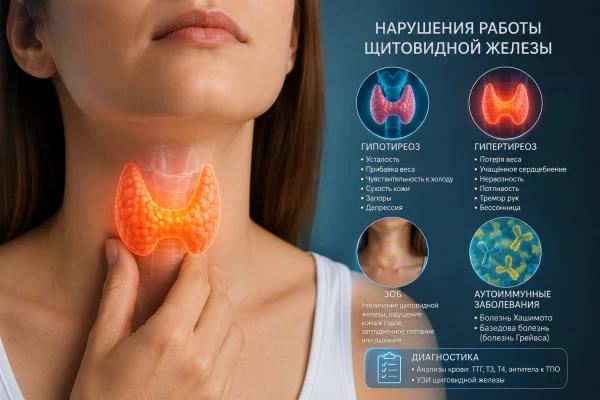
dull, dry skin and brittle hair are often linked to thyroid disorders;
-
disruptions in gastrointestinal function affect complexion, skin elasticity, and its ability to renew.
Therefore, when persistent changes in appearance occur, it is important to start not with experiments with cosmetics, but with a consultation with a doctor and an assessment of overall health.
Why Care Does Not Always Work
A common mistake is trying to 'revive' depleted skin with aggressive methods. In reality, it needs gentle restoration rather than stimulation. The greater the deficiency, the more careful the strategy should be – the principle of 'the more, the better' does not apply here.
The medical approach in such cases revolves around support and saturation:
-
gentle biorevitalization;
-
professional care procedures based on hydropeptides;
-
microcurrent therapy to improve microcirculation;
-
lymphotonics for those prone to swelling;
-
restoration of the skin barrier with creams, serums, and masks under the supervision of a specialist.
The key task of such a strategy is to return resources to the skin, not to provide a temporary visual effect.
Lifestyle: The Foundation of Skin Health
No procedure will yield lasting results if basic factors are ignored:
-
full sleep of at least 7–8 hours;
-
adequate water intake;
-
balanced nutrition with fats, proteins, and trace elements;
-
quitting smoking and excessive alcohol consumption;
-
a sensible approach to tanning and mandatory protection from ultraviolet rays.
The skin is the first to react to overloads and deficiencies – and often we notice this only after some time.
Healthy skin is not just the absence of rashes. It is tone, inner glow, the ability to recover and adapt.