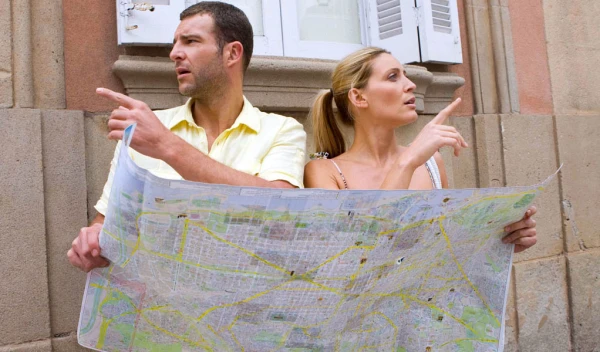
If you have ever wandered between "three pines," looked at a map and saw only incomprehensible letters, or felt panic when your phone with the lifesaving navigator was running out of battery, then you definitely know what topographical cretinism is.
Imagine you are walking down a familiar street, but suddenly you realize that you do not recognize the area and do not understand where to turn to reach your destination. You ask a passerby, but their explanations sound like a translation from Chinese. The only option is to turn on the navigator on your smartphone and, without even trying to understand what is displayed on the screen, blindly follow its instructions.
Perhaps your friends and relatives are joking about you, asking where you got lost this time? But it’s not funny — topographical cretinism (this disorder is informally called that) is quite a challenge. We will explain this condition and tell you how to cope with it.
What is topographical cretinism?
Despite the offensive name, there is no real cretinism involved here. It refers to topographical disorientation — a cognitive error, a neurological disorder, when a healthy person with normal memory, without mental retardation or deficiency, is unable to navigate in space — regardless of whether the environment is new to them or familiar.
Even if they know where they want to go, their brain seems to refuse to help them, even when they need to find an exit from a store or an underground passage.
Why does a person suffer from topographical cretinism?
This question also concerns scientists, although they have not found a clear answer to it. Topographical disorientation is a "failure" in the cognitive map of the brain, that is, in the neurons that create the image of the surrounding reality. They are formed and stored in a specific area of the brain — the hippocampus. If it is underdeveloped, then a person has difficulties with orientation in space, remembering routes, and so on.
Do not swear that you do not have it and will not have it: fatigue, lack of sleep, hunger, stress — in certain situations, all of this can affect quick orientation in space. Some scientists believe that the problem is "inherited" and can also arise in retrained left-handed individuals.
Symptoms
There are many symptoms: some get lost only in unfamiliar places, while others will use a navigator even from home to the store.
-
It is difficult to remember a route, even if they have walked or driven it multiple times;
-
Confusion in directions: "right" and "left" are just empty sounds;
-
A feeling of being lost even in familiar places, especially if something has changed, for example, if a store sign has changed.
How not to get lost in an unfamiliar place?
Orientation skills can be improved. Yes, it will take time, but you will stop getting lost in unfamiliar places.
Remember landmarks
Like in spy movies, look around, note interesting buildings, signs, monuments. They will help you return back.
Use a navigator
Turn on the maps, even if you are afraid of looking like a tourist. It’s better to be safe than to search for the way for hours. But at the same time, try to look not only at the phone screen but also around, correlating the map with reality.
Don’t hesitate to ask
People are usually happy to help.
Stick to major streets
Small alleys can lead you nowhere, while wide avenues will always lead you to main roads.
Look for signs
Cities have many indicators and signs.
Plan your route
Before heading out, study the map, mark key points to feel more confident. Try to set a segment that you will walk without hints. Imagine you are going through a quest. This will add excitement and help you relax.
Make sure you won’t be without connection
If a person is afraid of getting lost, it exacerbates disorientation. Charge your smartphone, take a power bank with you, download offline maps in case the Internet goes out.
Logic of city streets
For example, in Moscow, radii extend from the rings in the city center, while in St. Petersburg, all lines on Vasilievsky Island are parallel to each other.
Change your usual routes
Try going to work or school another way, via a parallel street. Plan to explore a part of the city where you rarely go on weekends. But such outings are better done with someone who is more oriented than you.
Don’t get distracted
If you are talking on the phone or listening to an audiobook along the way, you are unlikely to remember the route.