
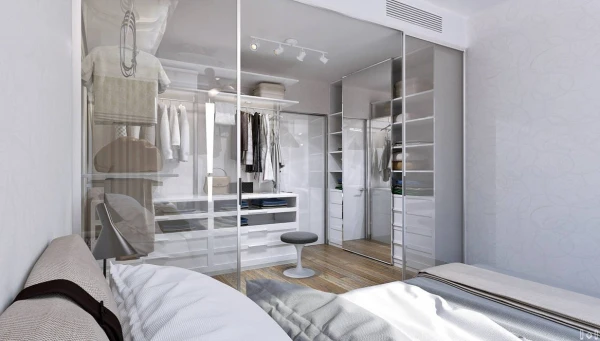
Well, what woman doesn’t dream of her own closet? A miniature space that belongs only to her, where dresses, shoes, jackets, and numerous bags "live." But what to do if the apartment is small, and there is no room for a separate dressing room? Maxim Lumpov, an expert in furniture technologies, explained how to equip a closet even in minimal space.
A Lady's Paradise in Three Square Meters
"I’ll start by saying that functionality does not always depend on size. We can create a comfortable space even in a small area. I would say that a comfortable closet starts at three square meters. What does this mean? For example, a niche that is 1–1.2 meters deep and 1.5–2 meters wide is already a great start. In such an area, you can fit: a rod for short items (shirts, blouses, skirts); pull-out drawers or shelves (for underwear, socks, t-shirts); overhead storage (for seasonal items, suitcases, or other rarely used items)," says the expert.
Inside, you can organize a safe, a small makeup area, and it is highly recommended to provide charging for household appliances (hairdryer, vacuum cleaner, iron), a vertical niche for an ironing board, and other functional zones. Be sure to include functional lighting.
To make the closet convenient, it is important to leave a distance of at least 80 cm between rows of shelves or cabinets. This will ensure free movement and comfortable access to items.
Linear or U-Shaped
You can organize storage along two walls, add space for shoes, and even place a mirror. Three meters is already a huge step towards order, which is much more effective than just a wardrobe.
Linear closet. "This is the simplest and most popular option. Storage is organized along one wall and is perfect for narrow, elongated spaces or part of a hallway. If the width allows, you can create a parallel layout, where storage is located on both sides of the passage. This is very efficient, but the passage between the shelves should be at least one meter so that you can move freely and open drawers," the expert clarifies.
U-shaped closet. This is the best solution for square or nearly square niches. Storage is organized along three walls, making such a closet maximally spacious. A spacious passage is important for it. This allows for free movement and access to all sides.
Action Plan for Beginners
Before deciding on the configuration, measure the length, width, and height, taking into account the location of outlets and windows. Assess your wardrobe. How many long items do you have, how much footwear, t-shirts? This will determine the ratio of shelves, rods, and drawers.
Function is more important than form. Do not try to squeeze a U-shaped closet into a narrow space. It is better to choose a more compact but convenient parallel layout.
Types of Storage Systems
Modular (mesh) systems. This is the most versatile option. Essentially, it is a set of racks and shelves that can be easily rearranged. Their main advantage is flexibility. They provide excellent air circulation and do not visually overload the space.
Stationary systems. Classic closets made to custom sizes. Their main advantage is reliability and perfect integration into the interior.
Facades
"The most practical material for the body is particleboard. It is definitely not worth saving on the quality of the board: this is the foundation of durability. The sliding door mechanism must be reliable. Choose trusted brands with an impeccable reputation whose products are designed for intensive use. If you need a closed option with doors, I recommend quality particleboard, glass facades, and for the 'comfort+' segment — MDF in enamel," noted the expert.
If you like glass doors, choose frosted, bronze, or graphite glass. The frame profile should be ultra-thin and almost invisible, with colors being black, white, or graphite, depending on the interior style.
The most sought-after colors are all shades of gray and beige, including khaki and graphite. Wood imitation is also popular, especially oak and walnut. Surfaces can be matte (smooth or textured), and handles can be hidden or integrated into the door. If the budget does not allow for full-quality facades and doors, stylish curtains can suffice. What you should not skimp on is hardware. Cheap drawer guides will break quickly, and low-quality rods will bend under the weight of clothes. Mechanisms with soft-close ensure smooth, quiet, and safe closing of doors. You definitely won’t regret the money spent.
Saving on planning is the biggest mistake. It is better to invest in a competent space organizer and a furniture manufacturer who can effectively implement all your tasks, helping to create a functional closet, than to struggle later with an inconvenient result.
















Leave a comment