
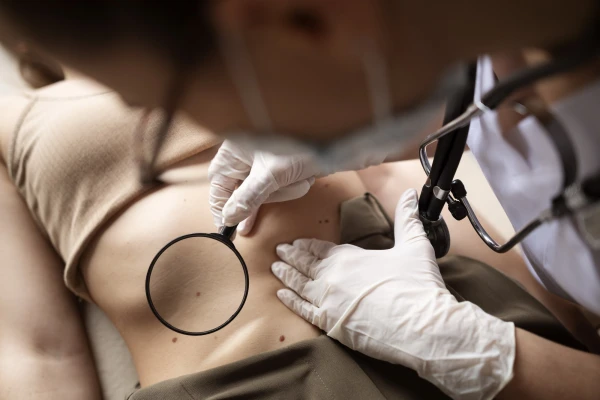
Not just moles: how to recognize malignant ones and raise the alarm in time.
The Doctor Highlighted the Main Signs
Most people have moles (nevi). The majority of them are benign and safe. But sometimes, even an "innocent spot" on the skin can start to change and turn into melanoma — one of the most aggressive types of skin cancer. How can you tell when it's time to see a doctor? And why is it important to monitor moles? Dermatovenerologist Pärvin Abbasova answers all these questions in detail.
"Melanoma is a tumor that develops from pigment cells (melanocytes). Its main feature is rapid growth and early metastasis. However, if melanoma is detected at an early stage, the chances of recovery exceed 90 percent," says the doctor.
Signs of a "Dangerous" Mole (ABCDE Rule)
It is impossible to determine with 100 percent certainty whether a mole is dangerous or not based solely on its appearance, but some signs do exist. Pärvin highlighted the most important ones:
1. A — Asymmetry
A normal mole is symmetrical. If you divide it in half, both parts look similar. An irregular shape is a reason to be cautious.
2. B — Border
Normally: clear, even borders.
Dangerous conditions: jagged, scalloped, or blurred edges.
3. C — Color
Benign nevi are uniform in color.
Suspicious: a combination of different shades (black, gray, red, white).
4. D — Diameter
Size larger than 6 mm (like a pencil eraser) or growth in a short period.
5. E — Evolving
The mole changes shape, color, starts to itch, bleed, or develop crusts.
Additional Worrisome Signs
The doctor also highlighted several alarming signs that you should not ignore:
— Appearance of a new mole after the age of 30.
— Inflammation or redness around it.
— Hair loss on the surface of the mole.
— Regular trauma (from a belt, strap, during shaving).
— Thickening or rapid growth over a week or several months.
When to See a Doctor?
If there is at least one of the listed signs. You can consult a dermatologist, a dermatovenerologist, or an oncologist.
The specialist notes that the doctor will conduct:
— Dermatoscopy — examination under magnification.
— If necessary — digital fixation for dynamic observation.
— If suspected — a biopsy for accurate diagnosis.
Can Risks Be Reduced?
Yes, prevention plays a huge role. Pärvin listed important rules that you need to follow to stay safe:
— Use SPF every day, especially in spring and summer.
— Avoid sunburns in childhood and adolescence.
— Avoid tanning beds.
— Photograph moles for self-monitoring.
— Have regular check-ups with a dermatologist (once a year, more often if there are multiple nevi).
Moles are not always trivial. If they change — it’s a signal. It’s better to check and ensure everything is fine than to miss the onset of a disease. Skin health is in your hands: observe, document, and do not delay a visit to the doctor at the slightest doubt.













Leave a comment