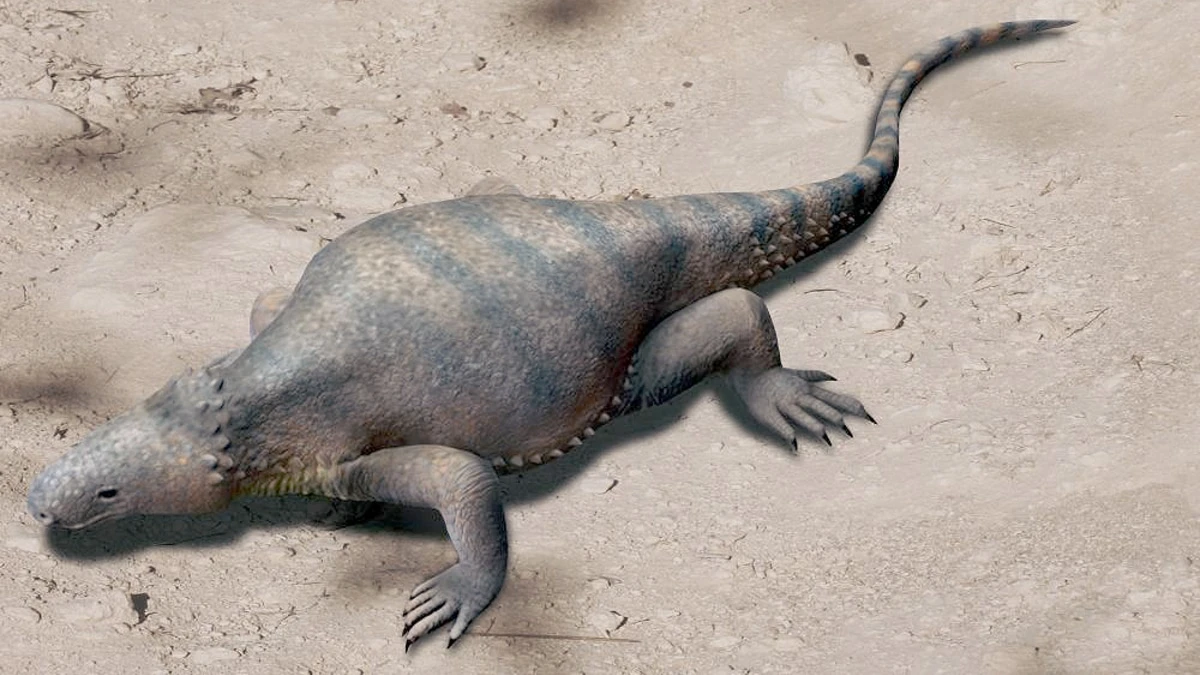
The age of Eunotosaurus is 265 million years.
Debates about the evolution of turtles have been ongoing for a long time. Molecular studies suggest a relationship between turtles and archosaurs, the modern representatives of which are birds and crocodiles. However, there are conflicting hypotheses regarding the relationship of turtles both with other living reptiles and with their closest fossil relatives. One such proposed ancient turtle was the Middle Permian Eunotosaurus africanus.
An international group of scientists in a study published in Current Biology used X-ray microtomography to examine the anatomy of Eunotosaurus and several "confirmed" ancient turtles. These included, for example, Proganochelys from the Late Triassic and Pappochelys from the Middle Triassic. The researchers compiled the largest morphological matrix to date — 962 traits for 226 species — and conducted a phylogenetic analysis.
The scientists constructed an evolutionary tree that required the fewest number of "steps." They tested various hypotheses about the origin of turtles: from captorhinids, pareiasaurs, lepidosaurs, and from aquatic sauropterygians. All these alternatives turned out to be less likely and required many assumptions.
The analysis placed Eunotosaurus in the group of primitive Permian reptiles Millerettidae. Eunotosaurus has many features that are not present in turtles and other modern reptiles. For example, it retains teeth on the bones of the skull base and lacks the laterosphenoid — a bone that forms the wall of the skull cavity in turtles. Additionally, it has flat and parietal bones of the skull, a separate fifth distal tarsal, and lacks the characteristic hooked fifth toe of turtles and other reptiles.
The broad ribs of Eunotosaurus, which were sometimes considered a precursor to the shell, actually evolved independently. This process is called convergent evolution. The authors link this to a burrowing lifestyle: Millerettidae, including Eunotosaurus, possess reinforced cervical vertebrae, a shortened body, broad ribs, and large claws. These same traits later appeared in early turtles, but in those, they were likely associated with a semi-aquatic lifestyle.
Turtles turned out to be one of the earliest branches of archosauromorphs, and their closest living relatives are crocodiles and birds. Turtles share 25 common anatomical traits with archosaurs, the descendants of archosauromorphs. Molecular data indicate that the split between the ancestors of turtles and archosaurs occurred about 255 million years ago, in the Late Permian. This position of turtles also narrowed the temporal gap in their history. The age of Eunotosaurus is 265 million years, the origin of modern reptiles is dated to about 260 million years ago, and the divergence of turtles and archosaurs is about 255 million years ago. Thus, the gap without fossils in turtles has decreased by 10 million years compared to the hypothesis involving Eunotosaurus.
The study shows that turtles belong to archosauromorphs and their closest living relatives are crocodiles and birds.