
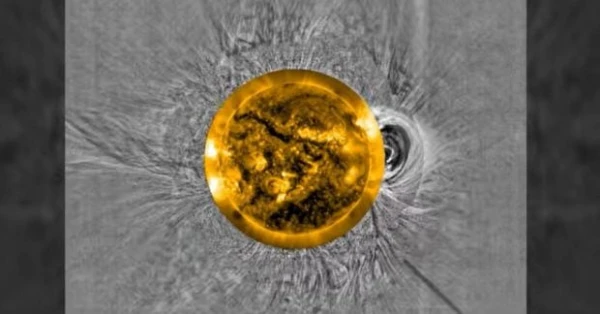
Recent studies have shown that the "slow" solar wind in the corona of our star is rushing 3-4 times faster than previously thought. This exciting discovery overturns our understanding of the Sun and its influence on the entire Solar System.
Scientists have made an astonishing discovery: the solar wind in the corona of our star can reach speeds 3–4 times higher than previously thought. These sensational conclusions were drawn after a detailed analysis of data collected by the Proba-3 mission of the European Space Agency.
Until recently, it was believed that the "slow" solar wind moves at a speed of about 100 km/s. However, fresh observations have shown that right at the surface of the Sun, its speed can soar to an impressive 480 km/s, nearly catching up with the "fast" wind.
The solar wind is a continuous stream of charged particles that disperses throughout our Solar System, significantly affecting Earth's magnetic field and provoking geomagnetic storms. Scientists suggest that the "slow" wind originates close to the solar surface during moments of magnetic line breakage and reconnection, but the details of this process remain a mystery.
Unlike the "fast" wind, which powerfully erupts from coronal holes—dark and cold areas with open magnetic lines in the upper layers of the solar atmosphere—the "slow" wind leaves the Sun in a completely different manner. It manifests unevenly, in discrete, separate streams.
Studying the solar corona has always been an incredibly challenging task due to the blinding brightness of the Sun itself, allowing observations only during rare solar eclipses. However, the Proba-3 mission has proposed a brilliant solution to this problem: two satellites simultaneously create an artificial eclipse, opening a unique opportunity for detailed study of the area right at the surface of our star.
Since its launch, the Proba-3 spacecraft have successfully conducted dozens of such observations, capturing completely unexpected accelerations of the solar wind. Scientists enthusiastically emphasize that this is just the first step in large-scale research aimed at finally revealing the true nature of all processes occurring on the Sun.
Asteroid Apophis: A Cosmic Visitor
The giant asteroid Apophis, with a diameter of about 340 meters, will soon fly past Earth, coming much closer than the Moon. For a long time, this cosmic wanderer was considered one of the most serious threats to humanity, but recent precise measurements have brought good news. They confirm that on April 13, 2029, it will safely pass our planet at a distance of about 32,000 kilometers.
This is astonishingly close—almost 12 times less than the average distance to the Moon, and even closer than the orbits of many geosynchronous satellites.














Leave a comment