
The Land of the Rising Sun continues to surprise with its automotive novelties.
Mitsubishi has officially announced the return of the legendary SUV Pajero. There are many myths surrounding the Pajero SUV; some are purely promotional, while others have objective grounds to call the car the "king of SUVs."
The truth is that Mitsubishi Heavy Industries created its first passenger all-terrain vehicle earlier than all Japanese competitors, back in 1934. It was the seven-seater RH33, intended for officers of the Kwantung Army. Mass production of the model could not be established, but it is remembered for its rare 6-cylinder diesel engine with direct injection, taken from a truck, with a volume of 6.7 liters and a power of 70 horsepower. Due to the high torque, the engine did not need a low gear!
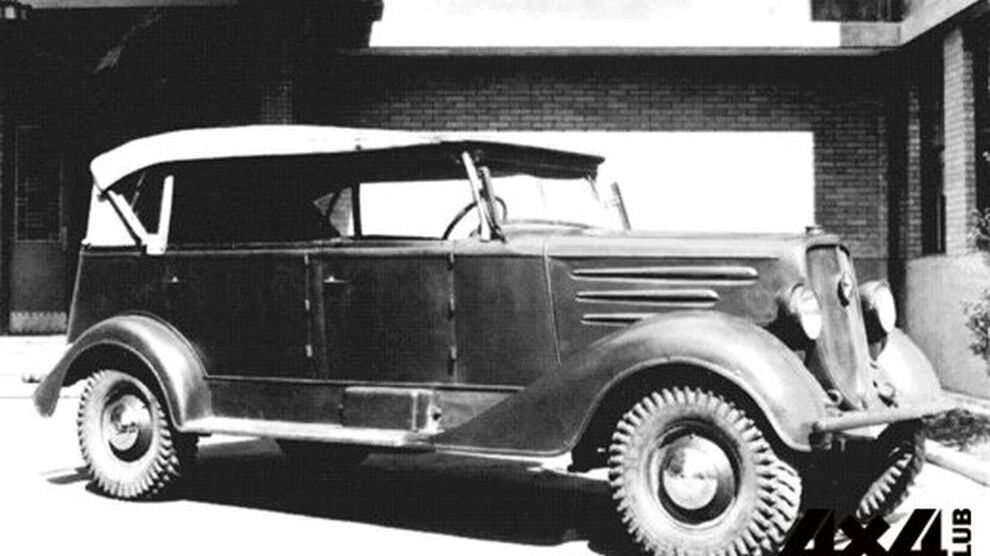
No RH33 has survived to this day. This is not accidental. After the war, the Japanese automotive industry abandoned its developments and switched to American prototypes. Among military SUVs, this was, of course, the licensed Jeep CJ3A. The Japanese CJ was supplemented with numerous modifications with different types of bodies and engines, remaining on the assembly line until 1997. Among its metamorphoses were a couple of civilian variants in a two-door convertible body. However, experiments did not go beyond small batches.
However, from the second half of the 1980s, Mitsubishi caught the global demand for civilian, comfortable, and fast SUVs.
In 1989, the first Pajero received a three-liter V6 gasoline engine with an injector, producing 141 horsepower, which allowed the maximum speed to increase to 160 km/h. To improve handling, the rear leaf springs were replaced with coils, and as an additional option, disc brakes on all wheels became available.
But global fame came to the second generation Pajero, presented in 1991. Against the backdrop of ordinary passenger cars of classes B and C, which dominated the roads of those years, the five-door SUV seemed like a luxurious house on wheels, easily overcoming any obstacles.

The pinnacle of its engine range was a V-shaped six-cylinder engine with a volume of 3.5 liters and a power of 208 hp. However, the main innovation was the SuperSelect 4WD transfer case. This system allowed for constant use of all-wheel drive or to disconnect the front axle to save fuel. On rough terrain, the central differential was locked. Unlike competitors, such as the Isuzu Rodeo, which actively experimented with various front-wheel engagement couplings, this was a significant progress. Another interesting feature was the adjustable stiffness shock absorbers, the operating modes of which could be easily switched with a button.
One of the key features that instantly earned the Pajero recognition was the independent front suspension with arms and longitudinal torsion bars. A quiet chain transfer case and automatic engagement of the front wheels added convenience (the front axle was engageable). In difficult road conditions, such as off-road or snow, a locking rear differential became an indispensable helper.
In Europe, the Pajero-2 had no competitors, as the royal Range Rover inhabited only the "heavy luxury" segment and was inaccessible to the middle class. In Japan and Asia, the Pajero clearly outperformed vehicles from more utilitarian Toyota and Nissan.
But Mitsubishi's supremacy was short-lived. In the late 1990s, the "Toyota" Land Cruisers emerged as the undisputed leaders, followed by the big German trio, which also produced their civilian SUVs. And, worst of all, by the mid-2000s, Mitsubishi faced serious financial problems, which prevented the company from creating new vehicles on new platforms. In 2006, the fourth generation Pajero appeared, which was only so in name. In reality, the "fourth" was a disguised facelift of the third series. The car was produced, more or less, without significant innovations until 2019, when it became clear that nothing more could be squeezed from the old platform, and there was nothing new.
More than six years have passed since then. And now, Mitsubishi's management announces the revival of the deceased brand. However, they have not yet decided to show the car, only circulating a darkened test specimen. It is said to be set to go into production in 2026.
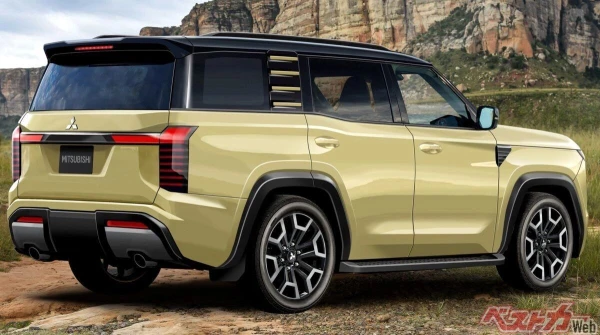
Of course, automotive designers have drawn their teasers for the future Pajero-5. The car shown in the teaser has a classic five-door body, roof rails, an almost vertical tailgate, a relief hood, and expanded wheel arches. One can also notice the complex shape of the LED headlights with an L-shaped upper part and horizontal elements that descend down, probably along the radiator grille.
Earlier, there were reports in the media that the development of the next generation Mitsubishi Pajero would be carried out in collaboration with Nissan. It is assumed that its "twin" will be the revived body-on-frame SUV Xterra. It should be noted that it has not yet been officially presented, and the previous version was discontinued in 2015. Its return to the North American market is expected in 2028.
If these rumors are confirmed, both models will have similar technical content. According to preliminary information, the new Nissan Xterra will be built on a new body-on-frame platform. It is expected that it may receive a hybrid powertrain based on a gasoline V6. Perhaps it will be a plug-in hybrid version with the ability to travel about 120 km solely on electric power. Official details about these technical specifications will be announced later.















Leave a comment