
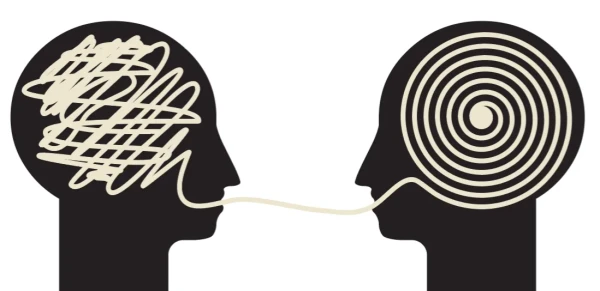
A person is capable of constructing sentences "on the fly" that they have never uttered before.
The basis of modern grammar lies in a theory that suggests language is "stored" in the human mind as hierarchical structures — groups of two words, where one component depends on the other, but together they form a whole in terms of meaning. However, linguists from Denmark have demonstrated that the structure of language may be simpler: many meaningful groups of words represent linear sequences rather than hierarchies.
Over the past year, scientists have managed to challenge or refute several fundamental theories related to the functioning of human language. For instance, it has been found that it is not Broca's area that is responsible for turning thoughts into speech, and that out of hundreds of "universal" rules of grammar, only a third apply to all languages of the world or most of them.
It is commonly believed that a person is capable of constructing sentences "on the fly" that they have never uttered before because there are certain representations of linguistic patterns in their mind according to which words can be combined into larger structures. How these patterns are formed and what they represent remains a mystery for cognitive science. Nevertheless, it is believed that the most accurate theory is the constituent grammar — a theory suggesting that language is "stored" in the mind as tree-like hierarchical structures, which in turn represent groups of words that can be replaced by a single element (for example, in English: the boy → he).
Linguists from Aarhus University in Denmark have noted that in English and — with a high degree of probability — in many other languages, there are groups of words that cannot be described within the framework of constituent grammar. An article arguing against the theory that essentially underpins all modern syntax (at least since the 1950s) was published in the scientific journal Nature Human Behaviour.
Constituent grammar suggests that words and phrases are combined into larger units according to certain principles. These units, which resemble a tree structure, are called constituents. For example, in the sentence She ate the cake, the definite article the and the noun cake form a noun phrase (since the "root" of the tree, the top of the hierarchy, the main word is the noun, not the article) the cake. This noun phrase connects with the verb ate, forming a verb phrase ate the cake. Together with the pronoun she, the verb phrase forms a complete sentence.
All constituents, including those discussed in the example above, are hierarchical, and their elements do not overlap. This means that constituents are either independent or fully nested within each other: there are no words that belong simultaneously to multiple groups. However, the authors of the article noted that many common sequences of three or four words in English do not meet these criteria. For example, the popular construction in the middle of the, if considered a constituent, would "layer" onto the noun phrase with the article the that follows in the sentence after the preposition of. The same can be said for the sequence can I have a.















Leave a comment