Flares of this level can lead not only to magnetic storms but also disrupt the operation of satellites, radio communications, and navigation.
Once, powerful solar storms affected humanity only by creating bright auroras. Today, civilization depends on electrical grids that facilitate the movement of goods, information, and people around the world. And although solar activity appears to be declining, the risks to Earth remain.
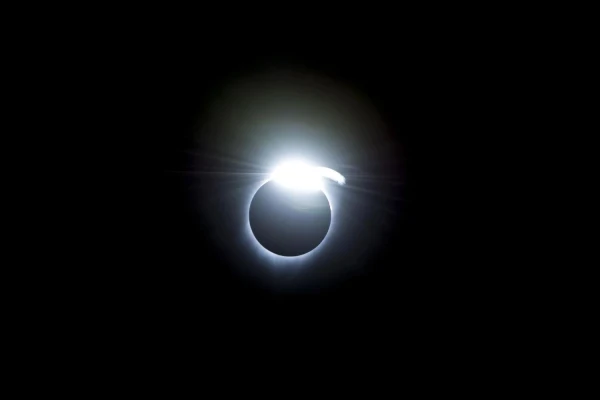
The current solar cycle is approaching a dramatic and scientifically interesting phase, and astronomers are observing the star more closely than ever before.
Solar activity is not constant: it changes within a cycle lasting about 11 years. Its peak (or maximum) is the period when sunspots, flares, and coronal mass ejections are observed most frequently. At its lowest point (solar minimum), these phenomena may not occur for months. Scientists believe that the current 25th cycle began in 2019, with its maximum occurring in 2024. This means that the entire year of 2025 falls within the declining phase of the current solar cycle, and this trend will continue for at least the next few months.
However, this does not mean that the likelihood of strong flares or geomagnetic storms has disappeared. Experts warn that Earth should not "relax" — surprises from the Sun are not over yet.
According to astronomers, 2025 will break the decade-long record for the number of days with magnetic storms (69), while in 2024 there were 44.
Even more significant was the increase in the total number of days with geomagnetic disturbances, during which the Kp index reached four or higher. There were 164 such days compared to 94, which is a 75% increase.
The Solar Astronomy Laboratory explained that the main factor contributing to the increase in storms was an unusually large number of coronal holes on the Sun.
"If last year the term 'coronal holes' was still little known, now these structures completely dominate the information agenda, overshadowing flares and other phenomena of solar activity," the experts noted.
Despite the fact that the current 25th solar cycle is in a pronounced declining phase, strong flares and powerful geomagnetic storms are still possible, notes astrophysicist Ryan French.
Experts from the Solar Astronomy Laboratory of IKI and ISZF also state that there are currently no signs of a systemic decrease in the number of coronal holes or a reduction in their size. Therefore, at least the first months of the upcoming 2026 will still be significantly influenced by them, and the number of magnetic storms will not decrease.
"Historically, the strongest solar phenomena most often occur during the declining phase of the cycle — sometimes even several years after the solar maximum," emphasized French.
For clarity, he referred to data from previous cycles — 23 and 24.
The Sun is Preparing for a 'Super Explosion': A Giant Spot is Accumulating Energy
In the first case, when the peak of solar activity occurred in 2001, there were ten flares stronger than X10: four in 2003, two in 2005, and one in 2006, years after the maximum.
Class X is considered the strongest. Flares of this level can lead not only to magnetic storms but also disrupt the operation of satellites, radio communications, and navigation.
Notably, the largest of them, which occurred in November 2003, is estimated to have reached levels of X28-X48 — due to the exceeding sensitivity of instruments at that time, it is difficult to determine the exact power. A solar flare of class X40 releases an enormous amount of energy — approximately equivalent to the explosion of ten billion megatons of TNT or the energy of a billion hydrogen bombs. The total energy of an event of this magnitude could meet modern global energy needs for hundreds of thousands of years.
Why Are We Observing It?
Once, powerful solar storms affected humanity only by creating bright auroras. Today, civilization depends on electrical grids that ensure the flow of information, delivery of goods, and movement of people around the world, notes Dagomar Degroot, an assistant professor of environmental history at Georgetown University.
But can a solar storm massively "shut down" all these vital systems for months or years? According to him, researchers are working on answers to such questions.
"One thing is clear: to protect these networks, scientists need to monitor the Sun in real-time. Then operators can reduce load or redirect electricity flows in the grids as a coronal ejection approaches. A little preparation can prevent a collapse," the expert believes.
However, not long ago, there were already concerns that the rapidly growing constellation of satellites in low Earth orbit is becoming increasingly vulnerable to space weather events. Scientists then suggested that the devices could start colliding within 2.8 days if they lose maneuverability during a solar storm. Such accidents carry a range of risks: both in orbit and on Earth.
What Else is Important to Know
The Sun and Earth's Climate. According to experts, the activity of the star within the 25th cycle may slightly alter the amount of energy received by our planet, but its impact on the global climate is small compared to greenhouse gases and other factors driven by human activity. At the same time, short-term effects may include slight changes in the upper layers of the atmosphere and processes capable of altering regional weather conditions.
Impact on Solar Panels. Ground devices generally produce approximately the same amount of energy regardless of solar activity, as the increase in overall radiation is minimal. However, panels on satellites may degrade faster in years of high activity due to increased radiation and partial exposure.
Flights During Strong Solar Storms. For most passengers on commercial flights, such flights are considered safe, as radiation levels remain within regulatory limits. The main risks concern airlines and crews, especially on polar routes, where flights may be redirected or operated at different altitudes.
How Active Will the Sun Be?
It is estimated that it will likely remain in a state of high activity in 2026. During this period, the number of sunspots is expected to remain relatively high compared to the early years of the cycle, and the frequency of flares and coronal mass ejections will exceed long-term averages.
Although, scientists explain, predicting the star's actions is not easy, as it represents a complex magnetohydrodynamic (MHD) system (where the flow of charged "liquid" and magnetic fields continuously interact). Recent solar activity has shown how calculations can miss the real picture.
Before this, many specialists had assumed that the new cycle would be weak — with a moderate number of spots and low peak activity. But contrary to initial estimates, the star turned out to be more "aggressive."
Throughout 2026, astronomers will analyze statistics on sunspots, flares, and coronal mass ejections to test and refine theories about how magnetic fields are generated and restructured within the Sun. At the same time, scientists will try to understand why some cycles are weak while others are strong. The lessons learned during current observations will help shape expectations for the 26th cycle and beyond.
For now, notes Science Times, the key takeaway is that the years around the solar maximum, including 2026, represent a period of increased but manageable risk for modern technological systems.