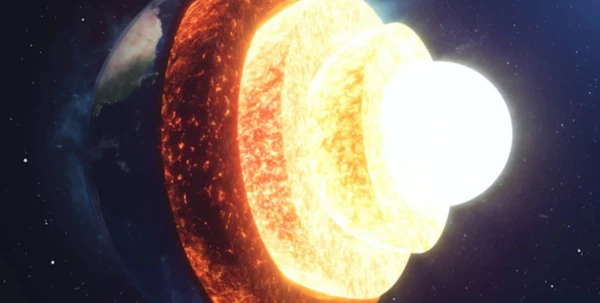
A recent study has revealed the existence of a new state of matter hidden right beneath our feet. It turns out that the planet's inner core conceals a "superionic state" that fuels the magnetic "heart" of our planet, writes Focus.
A new study has shown that the Earth's innermost core is not actually a conventional solid body, but exists in a "superionic state." In this strange state of matter, carbon atoms move freely like a liquid through a solid iron lattice, writes the Daily Mail.
It is believed that this allows the planet's inner core to behave like a solid body while remaining as malleable as molten metal. A group of Chinese scientists believes this corresponds to the peculiar behavior of the inner core that has puzzled scientists for years. Similarly, the flow of these liquid-like elements in the core may play a key role in maintaining the Earth's magnetic fields.
According to co-author of the study, Dr. Yucan Huang from Sichuan University, the diffusion of atoms within the inner core represents a previously overlooked source of energy for the geodynamo. In addition to heat and convection caused by compositional changes, the movement of light elements, akin to liquid motion, may contribute to the operation of the Earth's magnetic engine.
The Earth's inner core is a sphere of iron alloy weighing 102 quintillion tons and is one of the most extreme environments in the entire solar system. At a depth of about 5,000 kilometers beneath our feet, the core is compressed under pressures exceeding 3.3 million atmospheres and heated to temperatures close to those on the surface of the Sun.
However, the deepest layers of our planet also exhibit some strange and contradictory phenomena. For instance, while it is assumed that the core is solid, in other respects it behaves as if it were softened metal. Previous studies have already shown that seismic waves passing through the Earth's inner core slow down, similar to sound traveling through water. Data also indicate that the inner core essentially demonstrates a level of plasticity close to that of oil rather than steel.
It has taken years for scientists to understand how this part of the Earth can be both so solid and so pliable at the same time. One explanation is that it combines the behavior of both solid and liquid bodies in a single state of matter.
According to another co-author of the study, Professor Yujun Zhang from Sichuan University, in this strange state, carbon atoms become highly mobile, diffusing through a crystalline iron framework while the iron itself remains solid and ordered. This superionic state significantly reduces the rigidity of the inner core while still remaining solid.
2022 modeling showed that the planet's inner core could transition to this phase; however, the necessary conditions are so extreme that they are nearly impossible to replicate. In the study, the researchers subjected iron-carbon samples to powerful shock waves to recreate the conditions existing in the inner core.
As a result, the team accelerated the metal to speeds of 25,200 km/h, creating pressures of 1.38 million atmospheres and temperatures of around 2,300 °C. The researchers then analyzed the shock waves generated by these collisions and found that the iron and carbon samples became significantly more plastic as they approached the conditions observed in the planet's inner core.
All of this suggests that they transitioned to a superionic phase, and the metal in the core is likely in the same phase. The authors note that their findings could significantly change geologists' understanding of the planet's deepest layers. Essentially, this may not only explain why the inner core impedes seismic waves but also help us understand the planet's evolution.