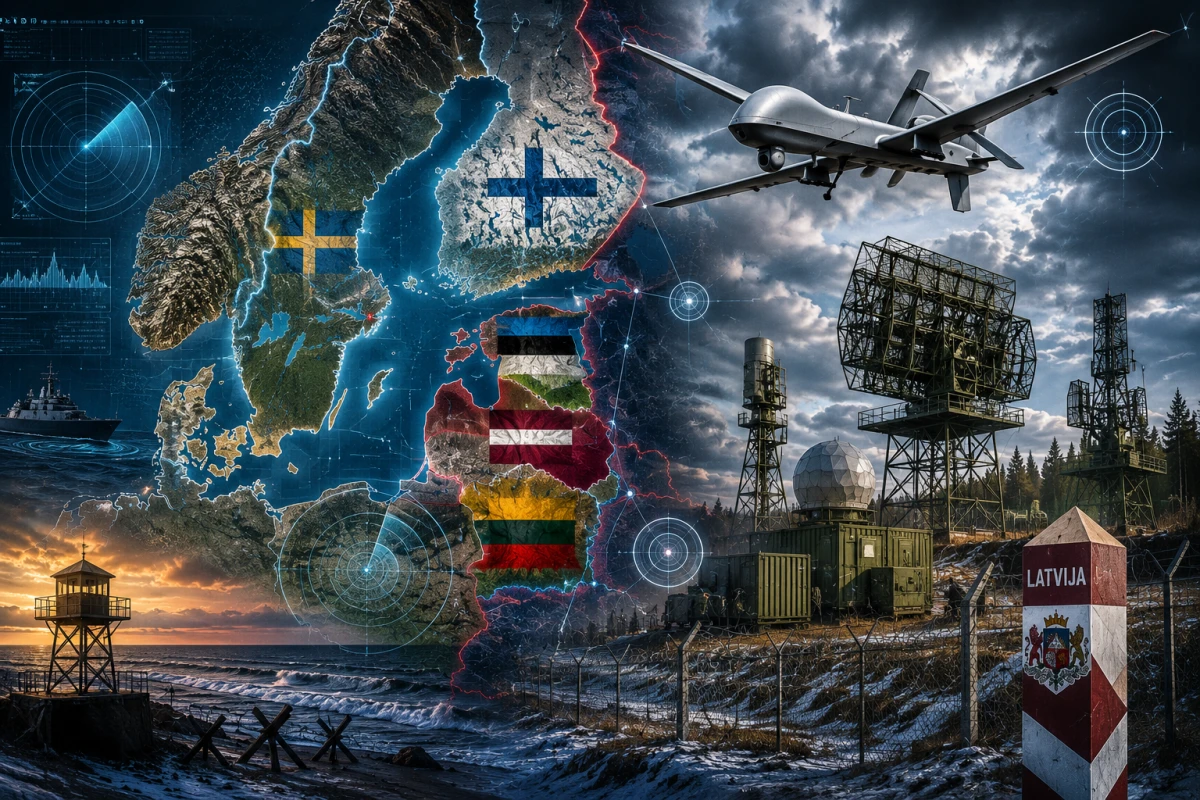
The appearance of drones in the airspace of the Baltic states and Finland raises serious concerns in the region. However, outside of Europe, assessments of the situation differ significantly: while EU countries speak of security risks, many foreign experts view such incidents as a side effect of the war between Russia and Ukraine.
In recent months, the topic of military drones appearing near the borders or in the airspace of the Baltic states and Finland has become one of the key issues in regional security, writes SestDiena.
Latvia's position on this matter largely aligns with the approach of most European Union countries and the European Commission. In the region, such incidents are seen as a serious security challenge that requires increased attention from military and civilian services.
However, there is no unified international assessment of the situation.
The administration of U.S. President Donald Trump has not publicly condemned Russia in connection with such cases. Moreover, a number of influential foreign analysts do not support claims that this is a targeted hybrid campaign against the Baltic states.
In particular, Chinese military and analytical platforms, which regularly study the use of drones in the war between Russia and Ukraine, offer a different explanation for the events.
According to a widely held view among Chinese experts, many of these incidents are related to the specifics of electronic warfare and counter-drone measures in border areas. It is noted that when drones are suppressed by electronic warfare means, they may lose orientation and deviate from their route.
Some analytical publications express the opinion that when protecting their own facilities, Russian forces primarily focus on neutralizing threats rather than preventing potential drone incursions into the airspace of neighboring states.
What is important to understand is that this issue concerns not only politics but also the rapidly changing nature of modern warfare, where drones are increasingly becoming a factor affecting the security of countries that are not directly involved in the conflict.
At the same time, many international observers note that it is unrealistic to expect a unified global response to such incidents. The approaches of the European Union, the U.S., and Global South countries on this issue differ significantly.
As a result, the discussion surrounding drones over the Baltic region is increasingly moving beyond purely military topics and becoming a matter of international political assessments and interpretations of events.