
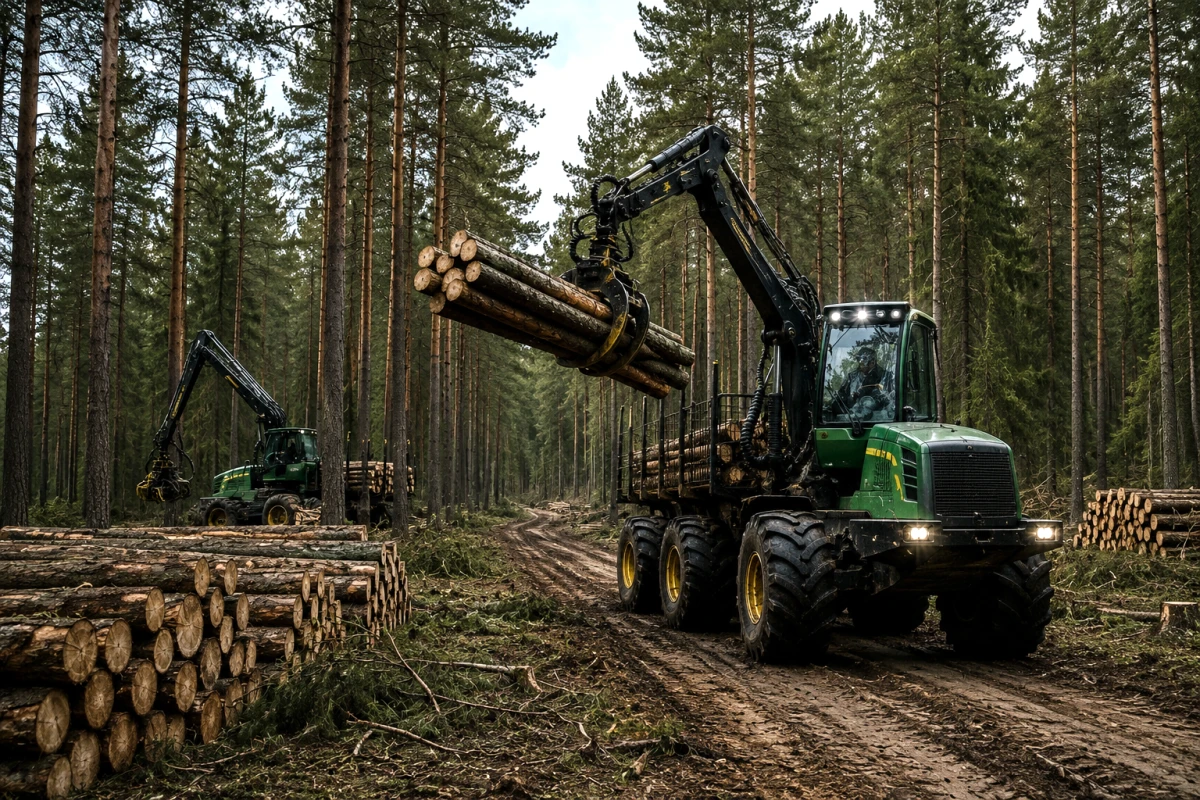
The State Audit Office identified serious problems in the management of Latvijas valsts meži (Latvian State Forests) and oversight by the Ministry of Agriculture. According to the auditors, disputed decisions regarding dividends, timber prices, and company management could cost the state hundreds of millions of euros.
The State Audit Office published the results of a large-scale audit concerning the operations of Latvijas valsts meži (LVM) and the actions of the Ministry of Agriculture as the holder of the state's shares in the enterprise. The audit revealed serious deficiencies in the company's management, strategic planning, and allocation of financial resources.
According to the auditors, the negative consequences for the state amount to many tens of millions of euros. This includes both unreceived dividends and losses due to decisions to lower timber prices for forest industry enterprises.
One of the most striking conclusions was the assertion that at least 130.3 million euros in additional dividends were not transferred to the state budget. Furthermore, the price changes for spruce and pine roundwood of grade II in 2024–2026, initiated by the Ministry of Agriculture and approved by the government, are estimated by the State Audit Office to reduce LVM's income by another 49.4 million euros.
The auditors believe that such decisions were made outside the competence of the Cabinet of Ministers and the shareholders of the enterprise.
In fact, this concerns the largest state forest enterprise in the country. LVM manages almost half of all forests in Latvia, and in 2024, it transferred over 141 million euros in dividends to the budget — this is more than a third of all dividend revenues from state enterprises.
The State Audit Office also criticized the company's financial planning. The audit showed that LVM's strategic indicators were systematically underestimated, while actual results frequently exceeded plans. For example, the EBITDA indicator in certain years reached 329% of the planned level.
At the same time, the enterprise was accumulating significant free funds. According to the audit, by the end of 2025, LVM could have over 405 million euros at its disposal, part of which did not have a clearly defined purpose for use.
Importantly, the audit is directly related to the so-called case of support for forest industry enterprises, which is already being investigated by the Prosecutor General's Office. The focus is on decisions to lower timber prices for individual enterprises in the sector.
The State Audit Office concluded that the report prepared by the Ministry of Agriculture, which served as the basis for the price changes, was incomplete and insufficiently substantiated. The auditors believe that the market analysis was conducted selectively and that threats to the industry may have been exaggerated.
The audit also raised questions about the corporate governance of LVM. In particular, the temporary board of the enterprise was reappointed annually for three years without an open competition, although the law allows such practice only in exceptional cases and for a limited time.
Moreover, after reducing the number of board and management members, new positions were created for former leaders, which, according to the auditors, effectively rendered the reforms a formality.
Against the backdrop of the audit publication, particular attention is drawn to the criminal proceedings already being conducted by the Prosecutor General's Office. Among those against whom proceedings have been initiated and investigative actions conducted are former Minister of Agriculture Armand Krauze, former and current officials of the ministry, LVM management, and representatives of the forestry sector.
Krauze himself previously denied causing harm to the state and claimed that the internal audit of the Ministry of Agriculture found no violations.
The State Audit Office provided the Ministry of Agriculture and LVM with eight recommendations. The auditors believe that their implementation should make the management of state forests more transparent and the financial policy more understandable and economically justified.
The publication of the audit increases pressure around one of the most sensitive economic and political cases in recent months, which affects both state finances and the influence of the forestry sector in Latvia.









Leave a comment