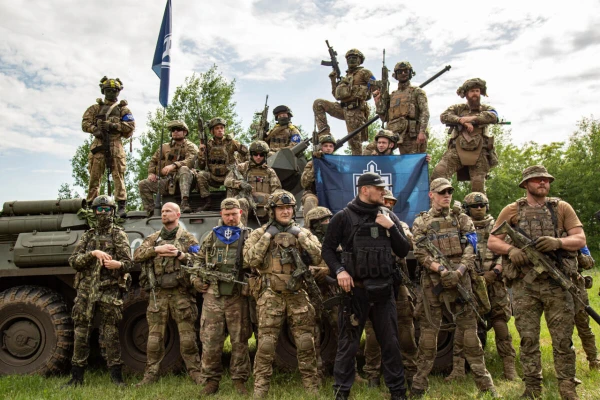
The Russian Volunteer Corps (RDK) is the largest unit of Russians fighting in Ukraine against Russia. According to its creators' design, the RDK is not only a military but also a political organization adhering to right-wing, nationalist views.
The ideology of the Kremlin is not the ideology of Russianness; it is the ideology of "Rossiyanstvo" and supranationality. It is built on loyalty to power. They have appropriated the word "Russian," and for them, "Russian" means one who is loyal to the political regime. <…> In our doctrine, we define a Russian as a member of the European family of nations, a bearer of the Russian language and culture," said a representative of the political wing of the RDK with the call sign Kasper (for security reasons, the interviewee does not disclose their identity) in an interview with LRT.lt.
– How many of you are in the Russian Volunteer Corps (RDK)?
– The exact number is classified, but we publicly state that the RDK is currently performing the task of a battalion, meaning it is essentially a battalion. We have assault platoons around which the entire military infrastructure is built. We have a command section, an intelligence section, a UAV section, an armored group, and a logistics section.
We still remain a tactical-level unit, but it is no longer like before when it was just a few small sabotage groups. Now it is a structure that can perform serious tasks.
– What kind of people serve in the RDK?
– We have people with very different levels of education: from PhDs to those who spent 30 years in prison and finished 9 grades. And they must be a unified organism. That’s why I conduct an integration course for our recruits. I tell them what European civilization is, where it came from, about Russianness, Russian literature, and so on. I show films.
We are currently trying to systematize this based on the model used in "Azov," in the Third Assault Brigade.
– How does your Russianness differ from the Kremlin's Russianness?
– The ideology of the Kremlin is not the ideology of Russianness; it is the ideology of "Rossiyanstvo" and supranationality, or simply an ideology that denies nationality. It is built on loyalty to power. They have appropriated the word "Russian," and for them, "Russian" means one who is loyal to the political regime, to put it briefly.
It should be noted that in Russia — in the Russian Empire, in the Soviet Union, and so on — throughout its history, starting from the Moscow and Vladimir-Suzdal principalities, there have been two competing projects. The first project is European. In our doctrine, we define a Russian as a member of the European family of nations, a bearer of the Russian language and culture.
The alternative project — what is now called Eurasianism — is cooperation with the Golden Horde. That is, absolute power, where what the one above you in the pyramid says is absolute truth, not subject to doubt. This is violence against one's own and so on.
– What place do modern citizens of Russia, who are not ethnically Russian, occupy in this concept of Russianness?
– We position ourselves as Russian nationalists, as European nationalists. It is important to distinguish nationalism from chauvinism. Chauvinism is hatred for others, which is very widespread in modern Russia. They primarily harbor hatred for those who try to form a nation, a national project. Why do they have such hatred for Ukrainians? Precisely because of this: the first goal — as he said, "denazification" — is the destruction of everything national in his understanding.
Our Russian nationalism is about love for our own. That is, I love the people with whom I feel a sense of community, and for me, these people are more valuable than others. But that does not mean that I must kill other people, create camps, and so on.
We declare the principle of good neighborliness and believe that, first and foremost, all European peoples, all European nationalists should be allies.
– How many Russian prisoners do you have who joined you, and what is their motivation?
– We try to ensure that they make up no more than 10% of the personnel because we do not want the culture of the unit to transform. Accordingly, we select them with heightened attention and care. But I believe that these people often have more motivation than volunteers because they have seen the evil that the Russian Federation brings primarily to its own.
We have people who have been tortured, who have been imprisoned on trumped-up charges. There are people who were previously criminals, but here in Ukraine, they have rethought a lot and understood what is what. When they saw how their comrades were being destroyed on an industrial scale and how commanders treated them as expendable material, many developed such motivation.
I tell everyone the story of a fighter with the call sign Ded, who spent 36 years in prison and, having watched Russian television, decided to sign a contract. He was in a privileged status — no one could force him to do it. He decided to "liberate the oppressed people of Donbas" one last time. He came, saw how everything actually looked, how the civilian population was bombed, and how many Russians were being destroyed in this meat grinder.
He took two Ukrainian special operations fighters prisoner. He was ordered to kill them, but he talked to them, and they convinced him otherwise. In the end, he swam across the Dnieper with them and said he wanted to join the Armed Forces of Ukraine. Now he is with us.
There was also a story — there is a video where two Russian soldiers are choking each other in a pit. Their commander put them there and said that only one would come out — kill each other. The winner is now with us. He managed to surrender later. He did not kill his opponent but put him in a chokehold, and that one lost consciousness. He ended up in the pit because they had extortion: the commander demanded they give part of their money, and he refused to pay — that’s why he ended up there.
He is an absolutely simple person without education, literacy, and so on. We worked with him: showed films, gave books, and he is actively engaging in the process. He is doing well; I think we will develop him quickly.
– What have you learned about Russian command and the style of warfare employed by Russia?
– I have lived in Russia almost my whole life, so I cannot say that anything surprised me. I have long known that they torture in prisons, that they kill the undesirables. I was not surprised by their attitude towards their own.
This New Year, I saw how a Russian soldier was cutting off his frostbitten leg with a knife. They just go and die by the hundreds every day, and no one cares. I don’t know what must be happening to the psyche of these people.
– We discussed before the interview that during this trip to Vilnius, you met with Lithuanian politicians. What did you discuss this time?
– A year ago, these were behind-the-scenes meetings, cautious introductions. Now it is a completely different level of reception, although the meeting also took place behind closed doors, so I won’t talk about the specific agenda.
The overall impression is that we were received very openly. I express great respect and gratitude for this. There were representatives from all parties, and at a very high level, including the Speaker of the Seimas.
For us, this is a very high level of reception. For me personally and for our organization, it is a great honor. It seemed to me that we were at least heard, and the answers I gave satisfied the interlocutors. I think there is a willingness to cooperate.