
Absurd proposals at the second reading stage have been supported!
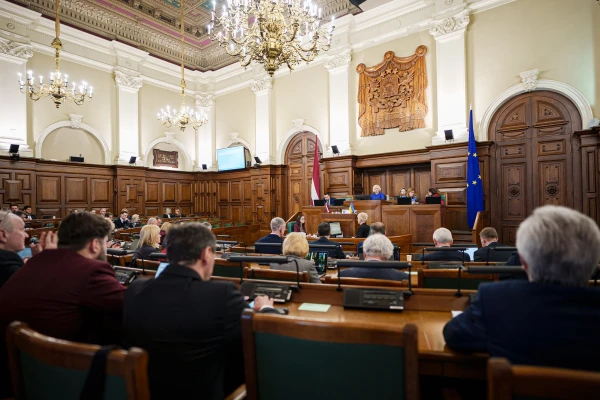
As previously reported, the "language" amendments proposed by the National Alliance deputy Nauris Puntulis to the Consumer Rights Protection Law were first approved by the Saeima's Economic Committee, and today the amendments reached the second reading approval at the parliamentary plenary session. The discussions were even longer than those in the committee. Recall that the first proposal by deputy Puntulis states that "communication between the consumer and the seller or service provider - providing, servicing information, and concluding a contract - is conducted in the state language."
Additionally, Puntulis proposes to establish in the law that consumers in Latvia have the right to receive services in the Latvian language.
The proposal stipulates that the service provider ensures that "documents prepared for providing services, used interfaces of digital content, as well as the possibility of choosing a language in such technical solutions as an application, website, call center, or in-person service infrastructure are in the Latvian language or, if the client agrees and the seller or service provider can provide it, in the official language of a member state or candidate country of the European Union. Thus, if the amendments are adopted in their current form, the seller will not be able to serve the customer, for example, in Russian, even if they wish to do so.
The leader of the Progressive parliamentary faction, Andris Šuvajevs, opposed these amendments: "The first section essentially states that for the consumer, communication occurs in the state language. This is in such a way, I understand, an imperative norm that any communication occurs only and exclusively in the state language. Its second section is more related to how it is possible or what obligations providers have to ensure other types of communication, for example, in digital interface environments, on the internet, and so on. It should take place in the Latvian language, and if the client agrees and if it can be provided, then it can also be in the official language of the European Union or a candidate country of the European Union. But then the third section complicates this norm extremely and makes, in my opinion, the internal logic simply illogical and unclear. After all, it is said that consumer rights are violated if the consumer does not receive information in the state language. So, there are three sections that are internally illogical, unclear, and their sequence is quite unclear."
Deputy from "Latvia First" Maia Armanjeva echoed him: "Well, I think it is no secret that this is an absurd proposal in its current form. Why? Because then I immediately have a question. Last year, Latvia was visited by, that is, 2.8 million tourists were registered in hotels. Then I have a question: how will these tourists enter a store and be able to buy something or receive some service? Because we are not talking about such languages, of course, as English, at least the same Japanese, and there are many other languages. How, for example, will a guide walk with their groups now around the city, around Riga, along the Jugendstil houses and tell about history? In what language? In Latvian? How, for example, will residents of Ukraine communicate with each other? Well, if they communicate in the language they are comfortable with or in which they understand each other. And it should be noted that the state language law still defines many things and is quite regulated.
"For the consumer, communication with the seller or service provider - providing, servicing information, and concluding a contract - occurs in the state language." Here it is understood as only and exclusively in the state language. I completely disagree and urge not to support it in this version."
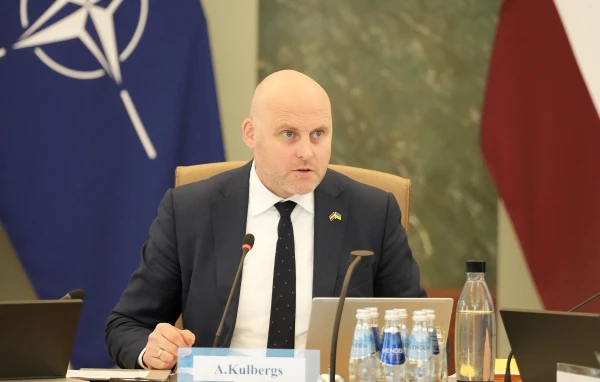
Unfortunately, the opponents of this absurd amendment by Puntulis found themselves in the minority. The amendment was supported by all deputies from "New Unity", the National Alliance, and almost the entire faction of the United List, except for Kučinskis and Kulbergs, who simply preferred not to vote. From the faction of the Union of Greens and Farmers, the ban on servicing in Russian was supported by the Speaker of the Saeima Daiga Mieriņa, the deputy head of the faction Augusts Brigmanis, as well as deputies Zemmer and Kļaviņš. The majority of the "green farmers" abstained. The "against" button was pressed by several deputies from the "Progressive" faction, the entire faction of "Latvia First", as well as deputies elected from the "Stability!" party.
There is still a third reading ahead, and the head of the Economic Committee, Kaspars Briškens, promises that Puntulis's amendments will be revised. We'll see...










Leave a comment