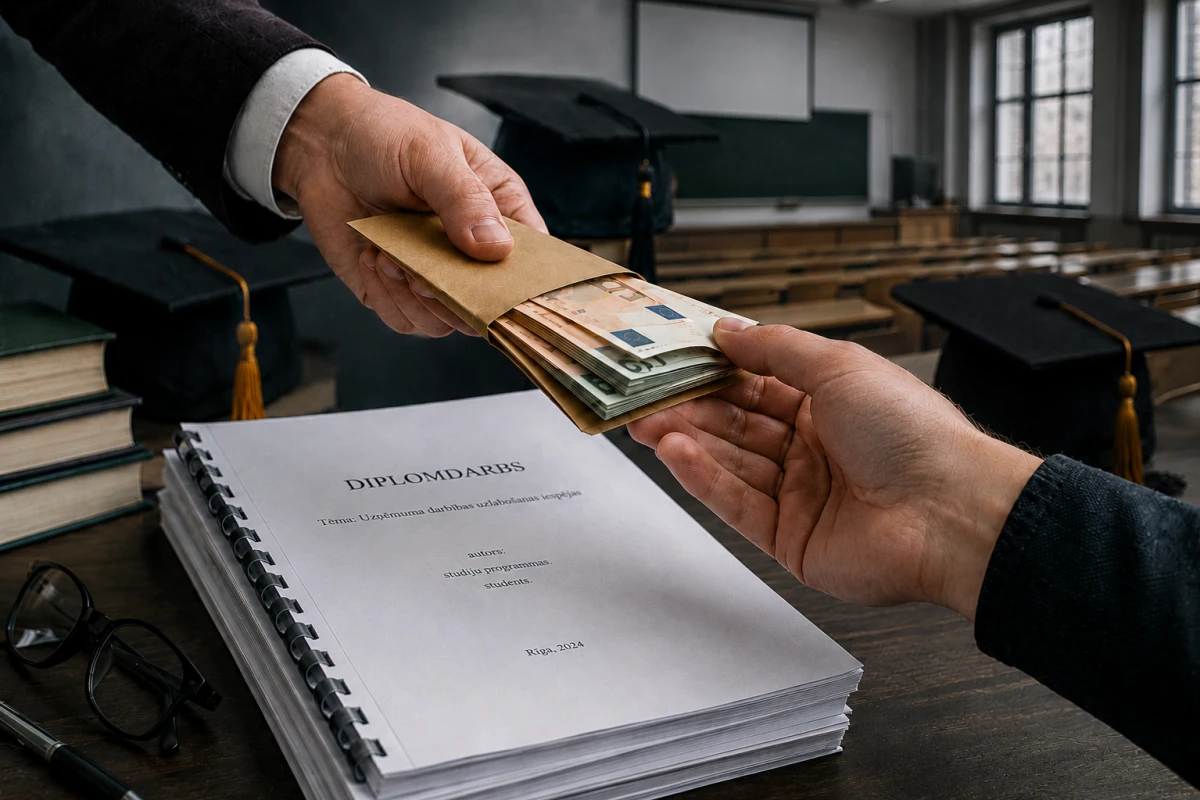
Despite the tightening of requirements for academic integrity, it is still easy to order a term paper, thesis, or master's work online. Moreover, such services in Latvia effectively remain outside direct prohibition, although the use of purchased works can lead to serious consequences for students.
A search for academic writing services leads to dozens of websites offering assistance in preparing educational and scientific texts, writes tv3.lv. The authors of the advertisements promise to relieve clients of stress and save time by taking on everything from term papers to master's theses.
The cost of services depends on the level of work. On some websites, a thesis can be prepared for about 200 euros, while a master's thesis costs around 250 euros. On others, the prices are significantly higher: a bachelor's thesis starts at 250 euros, a diploma thesis at 300 euros, and a master's thesis at 500 euros.
The ordering process is usually maximally simplified. The client only needs to specify the topic, volume, and deadlines for the work, after which they make a prepayment and wait for the result.
In recent years, an additional service has emerged — the rewriting of texts created by artificial intelligence. Some performers openly state that they are ready to revise the material in such a way that the use of AI is harder to detect during checks.
At the same time, many websites actively showcase their experience, the number of completed orders, and customer reviews. Some claim to have prepared more than five or even ten thousand works.
The list of offered topics covers almost all areas — from business and logistics to medicine, sports, and law. Often, the same performer claims competence in dozens of different disciplines.
The Ministry of Education and Science emphasizes that the sale of academic works in Latvia is not directly prohibited. However, problems arise when a student submits someone else's text as their own.
"If a student submits work prepared by another person as their own, it is considered a serious violation of academic integrity — authorship fraud, which is one form of plagiarism," the ministry explained.
They also remind that the legal author of the work is the person who wrote it. Accordingly, presenting someone else's text as one's own means providing false information.
According to the ministry, there is currently no specific legislation in Latvia that would directly prohibit the activities of such websites or provide for their blocking. Therefore, the control primarily falls on the educational institutions themselves, which check the authenticity of the submitted works and identify violations of academic integrity.
As a result, a paradoxical situation has arisen: it is possible to buy a thesis almost openly, but its use can lead to disciplinary sanctions for the student, including expulsion.
Until the state introduces separate regulations, the market for academic works continues to exist almost without restrictions, despite universities' efforts to combat plagiarism and authorship fraud.