The very bank that has been repeatedly criticized for refusing to communicate with clients in Russian has just sent your author a letter – notably, a paper one! – with explanations on how to use the new payment card. It was done in my native language. So, the criticism has likely been taken into account. But what is happening with the state language in the meantime?
No Unified System
€9,593,541 was spent in 2024-25 from various sources on teaching adults the Latvian language (of this amount, €355,790 was from municipalities). According to the PROVIDUS public policy center, 11,469 learners managed to acquire it – at least, that is the number of certificates issued. However, everything "testifies to an extremely fragmented picture"...
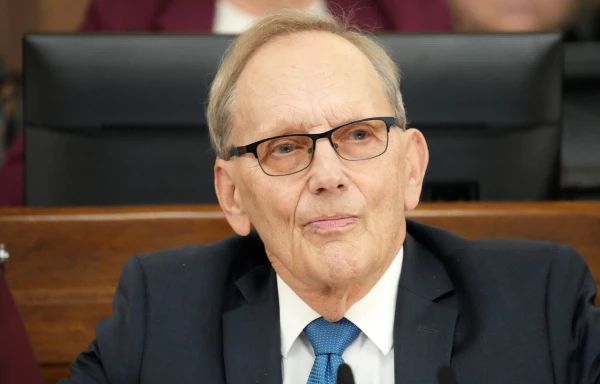
The head of the Saeima Commission on Citizenship, Migration, and Social Cohesion, Gunars Kutris (Union of Greens and Farmers), noted that Latvia as an independent state has lived for more than three and a half decades without realizing that teaching the state language does not fit into a unified system.
"There are no unified requirements... for the courses to have a known return," said the former head of the Constitutional Court.
Who Are All These People
Leading in the number of learners are, of course, citizens of Ukraine with temporary status in Latvia – in 2024, 4,802 people mastered grammar and vocabulary, and in 2025, another 2,869.
Next are "citizens of third countries" who have moved to our republic for various reasons – 779 and 571, respectively.
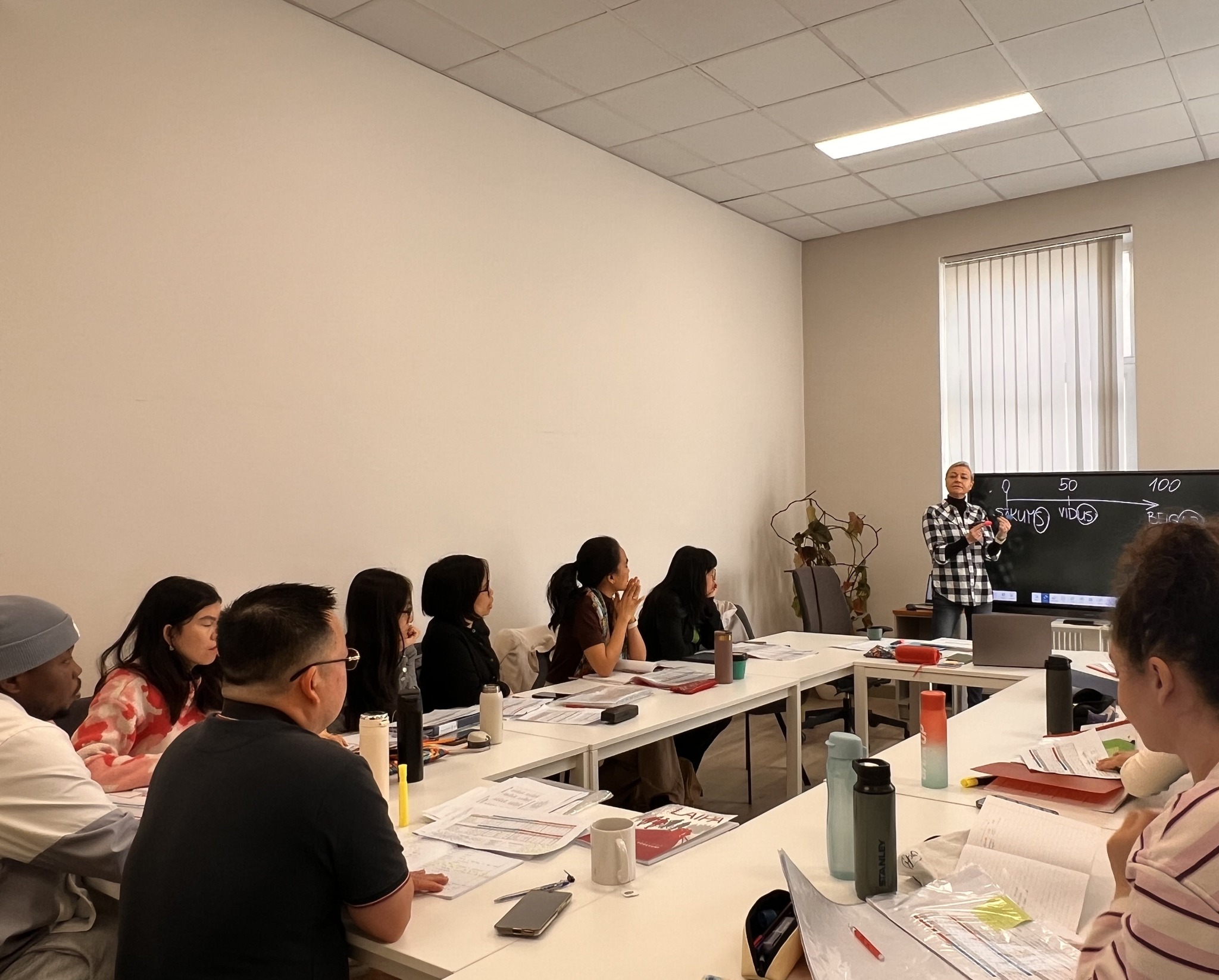
The most diligent students are from East Asia. Photo - inovacijucentrs.lv
Among the local residents, the largest group consists of clients of the State Employment Agency – 1,208 and 1,184 people attended courses at the labor exchange. Additionally, 56 learners over two years belong to the category of repatriates, according to data summarized by PROVIDUS director Sanda Liepina.
Meanwhile, the Ministry of Education and Science believes that a "transparent, data-driven system, integrated into the national education system, can flexibly respond to demographic, migration, and labor market needs" is being built.
A "module for mastering the state language" or the STARS platform is being created, which will combine data from 1) the State Information System of Education, 2) the State Inspection Information System, 3) the Citizenship and Migration Office, 4) the Public Integration Fund, and 5) the State Employment Agency. In a unified database, "information on the dynamics of language learning and career development of each client is available in a convenient format."
– People are dear, how long can we marinate this? – posed a rhetorical question G. Kutris. According to him, "state money" is being squandered.
Walking Through Torment
Lana Franceska Dreimane, Deputy Secretary of State at the Ministry of Education and Science for Higher Education, Science, and State Language Policy, acknowledged the "fragmentation of resources." There are also "unutilized target groups."
The state does not spare money on "one of the cornerstones," which is the state language – €6,185,934 is allocated for 2026, although the country is "in conditions of budget consolidation." It is expected that this year public funding will be available to 3,603 citizens of Ukraine, 2,629 unemployed individuals, 815 citizens of third countries, 30 re-emigrants, and 25 refugees. Funds from the European Cohesion Fund will go specifically to the diaspora.
The Ministry intends to have a clear picture – what the successes of each learner are, rather than "going in circles." All candidates for taking exams will be able to undergo a self-assessment procedure – from level A1 to C2 (available on the resource valoda.lv). Linguistic educators will receive methodological assistance for working with the Latvian language as a foreign language – and for teaching adults. And, of course, the development of new educational materials.
The STARS platform, according to L.F. Dreimane, provides information about private courses, training funded by European funds. On the resource stars.gov.lv, by the way, you can also find data about vocational education, offers for retraining from higher schools. A number of educational practices, according to the official, are "a bit archaic," but will still be useful, alongside modern, digital ones.
Deputy Raimonds Bergmanis (United List) expressed the wish that language exams across the country – from Riga to Daugavpils, be the same and transparent, similar to driving tests.
"For us, as a state, it is very important, – emphasized the weightlifter and former Minister of Defense. – We spend very large amounts of money." If graduates of language courses are unable to pass exams, then such institutions should be treated like driving schools whose students fail the driving test, i.e., revoke their licenses.
Such Disproportion
State language proficiency tests have been conducted in Latvia since 1992, and meanwhile, among the several dozen municipalities in the country, only seven provide assistance in courses.
Deputy Anna Rancane (New Unity) expressed the opinion that today some learners sign up for several courses at once, which creates a risk of double funding. The politician believes that mastering Latvian is better done in language clubs.
Arturs Butans (National Alliance) is concerned about "local residents who do not speak Latvian."
– Are they in any categories? Or only when they are unemployed?
In response, the officials present explained that, over the past 35 years, the state language has been mastered by non-Latvians to some extent. If not, they are either unemployed or may become so. Therefore, the State Employment Agency works with a group of "potential job seekers."
Nevertheless, A. Butans believes that "we are pouring water into a leaky bucket." People formally attend courses, and then go to work at Bolt, where they communicate in English, not Latvian. "I did not find this in the integration documents."
In response, specialists explained that there is a difference between proficiency and application of the language. And in Latvia, this is "extremely disproportionate." In several cities – for example, in the Latgale region – the linguistic environment itself does not support the language!
Moreover, according to expert assessments, people start thinking about state affairs, including the language, when their basic needs are met. Unfortunately, this is not the case for many residents of the country. …Interestingly, during the discussion in the Saeima, the term "artificial intelligence" was mentioned only once, and even then in passing. Meanwhile, today even exotic languages can be learned using the mobile app Duolingo, literally in one’s pocket. Why doesn’t our renowned IT industry step up to the times and provide smartphones with a trendy Latvian application? Meanwhile, unfortunately, many adult learners are still struggling with the textbook by Veksler and Juriks.