
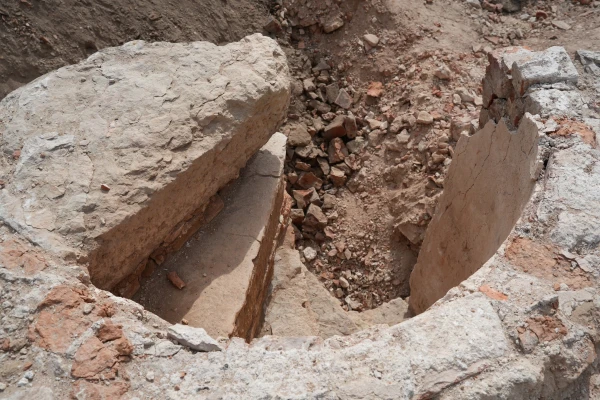
The Kuldiga regional municipality, implementing a cross-border project in collaboration with the H. Shoja Museum in Silale (Lithuania), has begun the conservation of the castle premises, during which previously little-studied and significant historical evidence of the ancient stone castle of Kuldiga has been revealed, reports LETA citing the municipality.
In the City Garden, where part of the Livonian Order castle has been preserved under a small hill, fragments of stone walls, stairs, various construction details, and a particularly well-preserved section of tiled floor were discovered during construction work. These findings provide new insights into the history of Kuldiga Castle and confirm its significance not only for the city but also for the cultural and historical heritage of all of Latvia.
The work is being carried out as part of the project "Heritage Stories: Shvexhna and Kuldiga Then and Now." Its goal is to preserve, restore, and open cultural heritage sites to the public while also developing cross-border cultural tourism in Shvexhna and Kuldiga, as well as creating tourist routes connecting both locations.
In Kuldiga, conservation work on the castle premises and the creation of a digital exhibition have begun as part of the project.
As explained by the local government, the aim of the work is to preserve one of the most vivid testimonies of the existence of Kuldiga Castle. The stone castle of Kuldiga, also known as Goldingen, was built on the left bank of the Venta River near the waterfall between 1242 and 1245 as the main stronghold of the Livonian Order in Courland.
In the Middle Ages, it was the residence of the commander of the Livonian Order, an administrative and military center of the region, and was located near an important trade route from Riga to Prussia. After the formation of the Duchy of Courland and Semigallia in 1561, the castle became the residence of the dukes and was repeatedly rebuilt and renovated. Later, during the Great Northern War, it was destroyed and abandoned, and its stones were used for building houses in Kuldiga in the 18th and 19th centuries. In the second half of the 19th century, a park was established on the site of the castle.
So far, the castle area has been relatively little studied. In the 1930s, local historian Valfrid Fromholds-Treis collected materials about it, and professional archaeological research was conducted on small plots in the early 21st century under the guidance of archaeologist Martins Lusens. Currently, work is also being conducted under archaeological supervision, and the initial findings already confirm that a rich historical heritage has been preserved under the embankment.
Currently, the external volume of the room's vault is being revealed so that the masonry can be pointed with lime mortar and external waterproofing can be created using a layer of clay mortar. The conservation work plans to strengthen the vaults and walls, clean and fill the joints inside the room, relay non-original supporting walls at the entrance, install new electrical wiring, and restore external doors and internal stairs.
During the removal of the embankment in the center of the City Garden, not only stone structures were discovered but also a well-preserved section of tiled floor. Some clay tiles show animal paw prints, providing insight into daily life during the time the castle existed. A rare find was also the ancient game markings discovered on one of the tiles. All findings will be thoroughly studied and dated, but it is already clear that some of them date back to the period of the rule of the Dukes of Courland and Semigallia.
In addition to conservation, the project also includes the creation of a digital exhibition with interactive elements. This will be developed by DJA LLC. For this purpose, historical research will be conducted, content developed, and necessary equipment installed. The exhibition is expected to tell about Kuldiga Castle as one of the most important sites in the history of the city, showing its significance in the context of the history of Kuldiga, Courland, Latvia, and Europe.
The conservation work is being carried out by Būvfirma INBUV LLC, archaeological supervision is provided by archaeologist Lusens, construction supervision is conducted by FM Grupa, and the documentation development and author supervision is handled by Arhitektes Ināras Caunītes birojs LLC. The total cost of the work is 179,429 euros excluding VAT.
The project is co-financed by the Interreg VI-A Latvia–Lithuania 2021–2027 program. The total budget of the project is 748,701 euros, of which 598,961 euros are funds from the European Regional Development Fund.








Leave a comment