
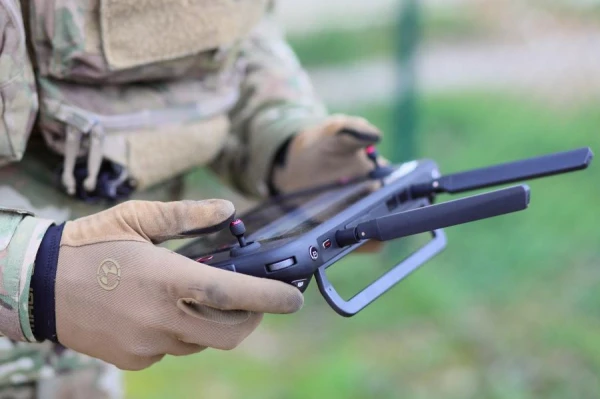
It is still unknown which aircraft approached the airspace of Latvia from the direction of Russia on Monday evening, said Defense Minister Andris Spruds in an interview with the TV3 program "900 seconds," LETA reports.
He reported that information from the past night is still being gathered, and it is evident that "there was also active, intense movement on the Estonian side." However, the specific aircraft that approached the airspace of Latvia has not been identified, and information about it is still being assessed.
The minister reiterated a previously expressed thought that it is not easy to accurately determine which object is being detected by radar. By certain parameters, similarities can be established, and it can be reasonably assumed that it is a drone, but its origin cannot be determined. Therefore, it remains only to speculate that the aircraft may be related to the war initiated by Russia against Ukraine, and it cannot be ruled out that it could have been a Ukrainian drone launched as part of legitimate self-defense against Russian attacks, but all of this is still just speculation, noted Spruds.
Commenting on the use of the cellular alert system, he acknowledged that this obviously met public expectations, as a balance is still being sought regarding in which situations such notifications should be sent and in which they should not. He again emphasized that initial information about a threat may not always be accurate, and it is quite possible that a flock of birds or another harmless object could have been mistaken for a drone.
As reported, on Monday evening, the Latvian army detected an unmanned aerial vehicle from a foreign state near the Latvian-Russian border, close to the territories of the Ludza and Balvi regions. The cellular alert system was activated to inform residents in the relevant regions.
The aircraft did not enter the airspace of Latvia. After it moved away from the border of Latvia, a message was sent out indicating the end of the threat.
Several residents of the Balvi region confirmed to the LETA agency that they received messages on their mobile phones from the alert system regarding both the potential threat and its conclusion.
As observed by the LETA agency, the initial information urging residents of the Balvi and Ludza regions not to approach a low-flying, suspicious, or dangerous object but to call the number 112 was also available in the mobile application "112 Latvija" and on the website "112.lv"; however, later this website was temporarily down.
As reported, last week drones flew into and exploded in all three Baltic countries. They were likely directed at targets in Russia as part of Ukraine's defense against Russian aggression, but they went off course or were diverted by electronic warfare means.
A drone flew into the airspace of Latvia from the direction of Russia on Wednesday night and exploded in the Kraslava region about a kilometer from the center of the Svarini parish, while another briefly entered from the direction of Belarus and headed towards Russia.
After this, a public discussion unfolded about the need for timely informing residents in such cases using the cellular alert system. The State Fire and Rescue Service (SFRS) reported that the corresponding text of the threat message in the airspace has already been prepared.












Leave a comment