With the arrival of spring weather, activity has begun in bird online broadcasts as well. Moreover, this year there is a new feature among them — a long-unseen species has been added.
The most popular bird pair in Latvia — the female sea eagle Milda and her mate Zorro — have begun to show activity in their nest in Durbe some time ago. On Thursday, the first egg of this season appeared, which the birds are now taking turns incubating, reports TV3 News.
<iframe width="560" height="315" src="https://www.youtube.com/embed/3wSd4iXrCw0?si=phrLwq-D6u1pGBoB" title="YouTube video player" frameborder="0" allow="accelerometer; autoplay; clipboard-write; encrypted-media; gyroscope; picture-in-picture; web-share" referrerpolicy="strict-origin-when-cross-origin" allowfullscreen></iframe>"We can expect other eggs as well. Usually, the interval between clutches is three days. In the Durbe nest over these 12 years, the average time for laying an egg has been the beginning of the second decade of March. So this year everything is going, so to speak, 'on schedule'," said Janis Kuze, a member of the board of the Latvian Fund for Nature and the project manager for the broadcasts.
The most attentive birdwatchers may have noticed that the view of the nest in Durbe has changed slightly. This is because, for safety reasons, the nest has been additionally reinforced this year. Moreover, the eagles themselves have brought more materials than ever before while arranging their home.
"Now this nest is as stable as it has ever been in its existence. Probably, if it ever falls, it will only do so along with the top of the tree. Therefore, the eagles built it higher than before. Then we will have to think about what to do — most likely, we will have to raise the camera sensor itself higher," Kuze said.
Last season, the pair of sea eagles successfully raised two chicks — Leo and Neo. How will it be this year? As many viewers of the broadcasts know, it is hard to say because nature is unpredictable.
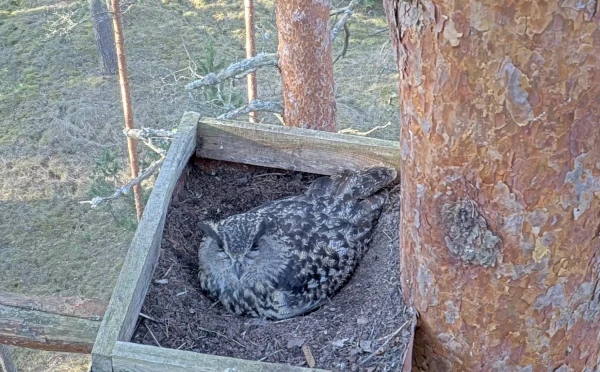
In addition to broadcasts featuring sea eagles and other already familiar birds, this year there will be a new feature — or rather a return. After a six-year break, it will once again be possible to observe the lives of the largest owls in Latvia — the Eurasian eagle-owls — in their nest.
<iframe width="560" height="315" src="https://www.youtube.com/embed/bbgoN8Hoigg?si=JGeH6HjJ9_E1zkVG" title="YouTube video player" frameborder="0" allow="accelerometer; autoplay; clipboard-write; encrypted-media; gyroscope; picture-in-picture; web-share" referrerpolicy="strict-origin-when-cross-origin" allowfullscreen></iframe>Such a long wait for the return of the owls to the screens was necessary because only five to eight active nests are known in Latvia, and their total number does not reach fifty. Many of them are located in places where it is impossible to install cameras or where they could be noticed by people, thus disturbing the birds. However, a suitable location has now been found — in a sparse pine forest in the vicinity of Riga.
"Right now, the female is settling in the nest, so to speak, getting comfortable, testing the nest. Of course, the question of when the eggs will appear is always relevant. But nothing can be guaranteed or predicted here. They should appear soon, but I cannot name an exact date," said ornithologist and eagle-owl researcher Peteris Daknis.
There is also another feature — since eagle-owls, like other nocturnal birds, are active at night, this broadcast is conducted with night vision. Therefore, viewers will be able to observe life in the nest even during the dark hours.