
While Latvia has been experiencing stable frosts for several weeks, life at the Riga Zoo goes on as usual. For some inhabitants, this is a time for moving to heated spaces and special care, while others happily enjoy the winter chill.
Animals that are used to harsh winter conditions in the wild remain outside in our climate, writes tv3.lv. Their bodies instinctively prepare for winter by growing thick fur and accumulating a layer of fat. As zoo representative Maris Lielkalns explains: “Winter comes every year, and the animals prepare very well on their own.”
However, exotic animals or those whose ancestors come from warm southern countries do not fare well in the Latvian winter. When the summer warmth recedes, they are moved indoors, where the necessary temperature is maintained: heating lamps and radiators are installed.
For animals that do not experience winter in their natural habitat, stepping into the snow would mean death. As Lielkalns notes: “We let the turtles out in the summer to warm up in the sun, but such conditions and winters are impossible for them. Turtles are cold-blooded animals; at such temperatures, they would freeze to death and would not warm up again.”
There are also animals for which both warm indoor spaces and outdoor enclosures are provided. For example, large antelopes can withstand a few degrees below zero but return to warmth in the evening. The lion also willingly goes outside, patrols the territory, observes what is happening, and then returns to a warm shelter.
The zoo also keeps an eye on weather forecasts. During extreme weather conditions, such as during a snowstorm, all animals are moved indoors whenever possible. Surrounding trees are also checked to ensure they do not pose a threat during strong gusts of wind.
The main thing is that they are fed
In winter, the diet changes, although none of the animals switch to warm drinks or special treats, as sudden changes can lead to unpredictable consequences. However, the approach to feeding changes.
Animals outside are given smaller portions more frequently so that the food does not freeze quickly. Juicy vegetables, which the animals love, are also given several times a day in small portions. There are no issues with water — heated drinking bowls are installed in the enclosures to prevent the water from freezing easily.
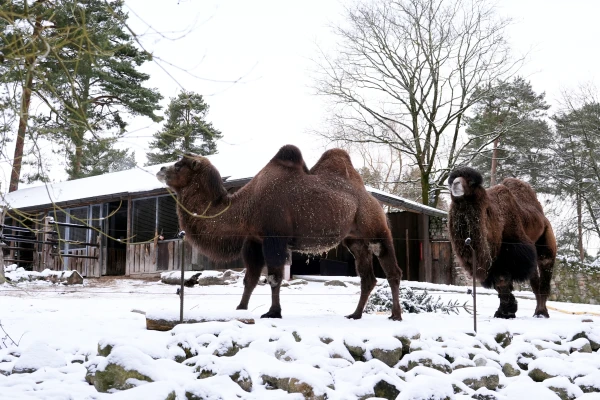
There are slight changes in the diet: predators are given warmed meat in winter, while camels, who eat fresh grass in summer, have to settle for hay in winter.
At the same time, animals consume the most food not in winter but in autumn — to build up an extra layer of fat in advance and retain heat. Some reptiles that will hibernate are also fed in autumn, then placed in a basement at around +5 degrees Celsius, where they rest until spring.
After the New Year holidays, the animals receive another treat — unsold Christmas trees. In the zoo, this is a source of vitamins. Animals eagerly eat both the needles and the bark. For those who do not like the trees, they are used as cozy winter “bedding” to keep warm. Lions and lynxes, which are more active in winter, use the trees to train their hunting instincts by tearing them apart.
The camels already have “spring” in their heads
There are also zoo inhabitants that are currently more active than in summer. August the tiger, who will soon celebrate his eighth birthday, is much livelier in cold weather, as his subspecies lives in Siberia, where winters are significantly harsher.
The camels are now entering an active period — a sort of “spring.” They develop foam at the mouth, grind their teeth, and often rub against the fence to smell like the essential oils of fir trees and be ready to meet females during the mating season. Lynxes are also in their most active period — the mating season.












Leave a comment