
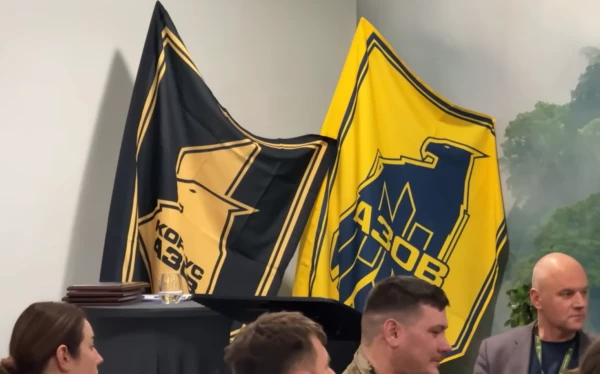
The Latvian government continues to prepare for war — this is evidenced, at least, by the fact that at the last Cabinet meeting this Tuesday, out of 11 documents considered in closed session or secret, 4 were presented by Defense Minister Andris Spruds ('Progressives').
A Proposal That Is Hard to Refuse
Latvia is ahead of its neighbors in creating foreign legions — this conclusion was made by Estonian military analyst Meelis Oidsalu on the analytical portal balticsentinel.eu.
As noted on the website focused on security issues in the Baltic region, on November 17, European Commission Commissioner for Defense and Space Andrius Kubilius "made an unexpected proposal: to consider the future possibility of deploying a Ukrainian battalion in Lithuania alongside the permanently stationed German brigade and rotational U.S. forces as an additional security guarantee in the Baltic region."
"It would be good if, after peace is achieved in Ukraine, the experienced Ukrainian army was ready to be present in all countries of our border region," Kubilius explained his point of view.
"NATO and its member states, – the portal notes, – are already actively working on assimilating Ukraine's combat experience, but mainly through official military cooperation, joint seminars, and similar formats. Since this year, this is also being done through the Ukraine–NATO joint knowledge exchange center established in Poland. NATO has several such 'training bridges'; one of them — the NATO Cooperative Cyber Defence Centre of Excellence — is located in Estonia, and Ukraine participates in the work of this center."
The British Ministry of Defense, which has trained 50,000 soldiers of the Ukrainian Armed Forces, offers "reverse mentoring" from those Ukrainians who have gone through the crucible of battles and destroyed, according to the data from Her Majesty's government, 4,000 Russian tanks. However, "at the beginning of the Russian aggression, the North Atlantic Alliance maintained an extraordinarily low level of political and military activity, and the processes of training Ukraine on the battlefield were not publicly discussed."
"Latvia Has Legalized Foreign Legionnaires"
This is the title of one section of the material on the website. In October 2024, the Saeima amended the Law on Military Service, which now allows voluntary participation in the defense of Latvia not only from citizens of the country but also from citizens of EU, NATO, Australia, New Zealand, Brazil, and Ukraine.
"This is possible provided that candidates successfully pass background checks, speak Latvian, English, or French (the latter two are NATO's official languages), and have not previously served in Soviet structures." By the latter, it is meant the Armed Forces of the USSR, which automatically excludes applicants aged approximately 55 and older.
However, as noted in balticsentinel.eu: "Not everything that works in Ukraine will necessarily yield equally good results in other geographical or social conditions. A mandatory part of the training process is the critical transfer of Ukrainian experience to local realities."
Latvia's desire to expand its military contingent with Ukrainian citizens has not yet triggered similar trends in neighboring states. For example, the young NATO member Finland believes it has a "sufficiently trained reserve," as stated by Ministry of Defense representative Nina Hirski. For her part, Estonia's Ministry of Defense spokesperson Major Taavi Karotamm believes that "attracting foreigners to military service may be necessary and beneficial."
"Including in situations where the risk of war increases, but for political reasons it is impossible to declare a state of war or announce mobilization, i.e., formal peace time is still maintained," adds balticsentinel.eu.
"I Would 'Buy' an Expert from Kherson Today"
This is what former commander of the Estonian Defense Forces General Martin Herem says, who frequently travels to Ukraine. According to him, an invited specialist "could explain how they reduce the effectiveness of Russian FPV drones to 5 percent using electronic warfare, fire, networks, and the destruction of enemy reconnaissance and operators." "I would ask him to imagine an unpopular scenario of 'what if war started tomorrow' and describe how he would use specialists with experience from the Ukrainian war," says the retired military leader.
So far, the recruitment of personnel from the Ukrainian Armed Forces in Estonia is happening through private military companies that bring together retired officers of the Estonian army. For example, a Ukrainian drone unit was involved in recent Estonian-British military maneuvers. Such units are called "red teams," and they imitate the style of the Russians.
"Such reasoning may seem cynical, but if active combat operations in Ukraine cease at some point, hundreds of thousands of Ukrainians with military experience will enter the European labor market, – notes balticsentinel.eu. – It is likely that a race will begin to attract the best specialists who participated in the war for Ukraine's independence to private companies or — as is already planned in Latvia — directly into the armed forces."
In all this, "the amendment introduced by Latvia last year, allowing foreign fighters to join the armed forces, directly links such service to mobilization, allows avoiding legal and personnel risks associated with the permanent composition of peacetime, and establishes clear prohibitions..."
Welcome, or No Entry for Outsiders
Another important nuance that has not been addressed by Baltic analysts is how the arrival of hundreds, and perhaps thousands, of veterans of the Ukrainian Armed Forces who fought against the Russian Federation, including in the Kursk region, will affect the socio-political climate in our republic.
After all, it is clear that these people will live among us, carry out daily household chores, and their children will attend the same schools. Moreover, the arrival of these uniformed guest workers will certainly be in demand by local media and social platforms. Perhaps they will even be invited to the same educational institutions to share their experiences. Thus, the possibilities for social engineering are truly boundless.
In this regard, historical precedents come to mind — after all, the Janissaries, who were taken from their families in childhood by the sultans of the Ottoman Empire to suppress conquered peoples, later made many decisions in the Sublime Porte. And in the Roman Empire during its decline — the barbarians called into the legions looted the Eternal City and settled on its throne themselves!






Leave a comment