The famous jeweler, according to the plot, is entangled in personal and social issues.
A major premiere took place on the Main Stage of the Vakhtangov Theatre in Moscow - the play "Brilliance and Ashes" (16+) directed by Anatoly Shulyev. He is also the author of the idea for this family saga about a Russian jewelry dynasty.
As Anatoly Shulyev confessed, he once came across a book about the Cartier jewelry house. He became interested. Drawing from the history of French jewelers, Shulyev decided to explore the lives of their Russian counterparts. Carl Fabergé is the first name that comes to mind in this context. But he is not the only one. There were others, such as Pavel Ovchinnikov - a master goldsmith, one of the founders of the Russian jewelry school. By origin, he was from serf peasants, hailing from the village of Otradnoye (now part of Moscow). As a teenager, he studied in a workshop producing gold and silver items. He gained his freedom. He got married. With his wife's dowry, he established his own workshop, which later became a profitable factory. His success was as swift as a rocket. Ovchinnikov won awards at international exhibitions, received orders and medals, and became a supplier to the Court of His Imperial Majesty long before Fabergé.
This remarkable man became the prototype for the main character in the play "Brilliance and Ashes." In the Vakhtangov production, he is called Pavel Kuteinikov. His biography contains traits and events from the lives of other masters.
According to Shulyev's synopsis, the play was written by poet, playwright, and actor Sergey Plotov. The director took on the task of finding an actor for the lead role. He says he searched for a long time. He found no better candidate than Viktor Sukhorukov.
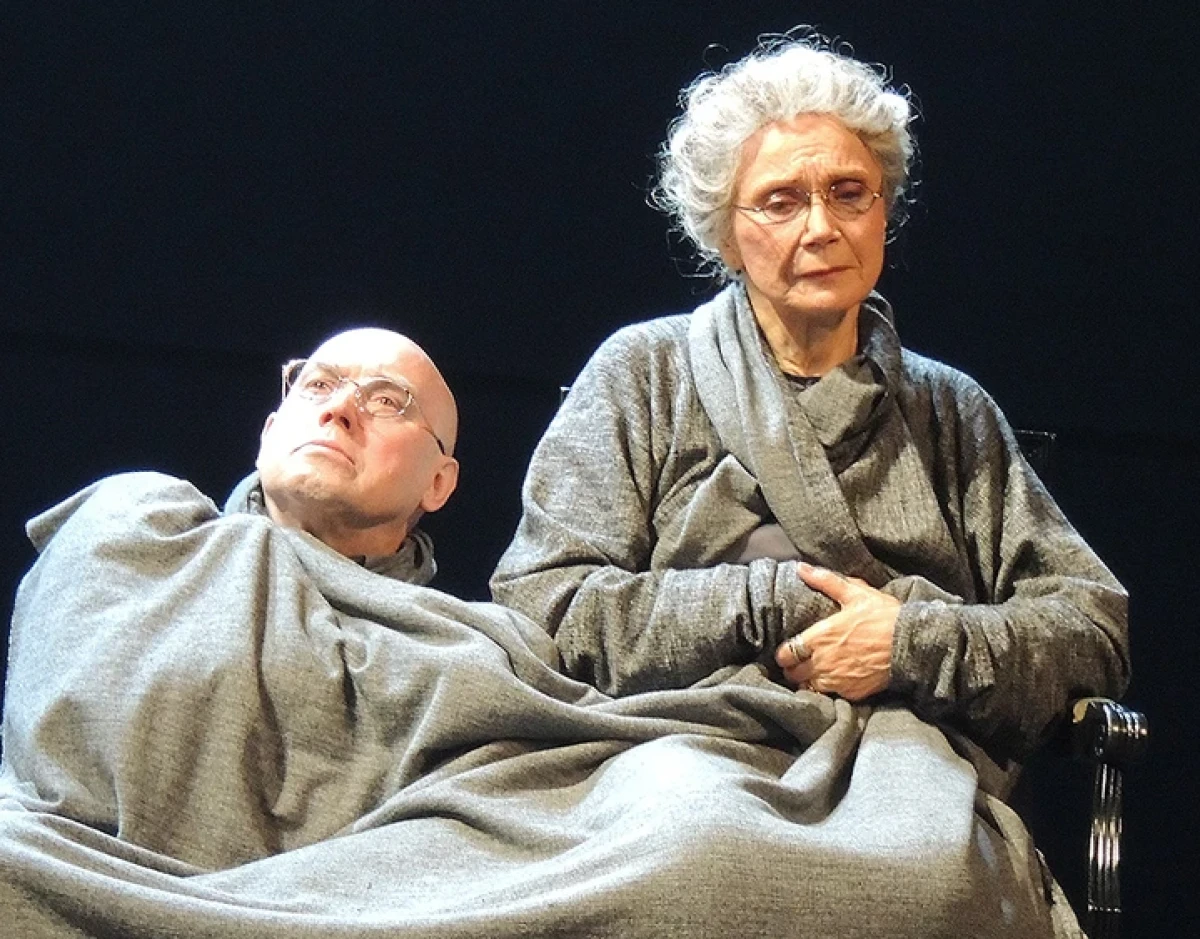
- In my anniversary year (Sukhorukov will turn 75 in November - Ed.), I received another invitation from the Vakhtangov Theatre, - Viktor Sukhorukov confessed to us. - I haven't worked in a state theatre for a long time. But the story was such that I agreed immediately.
People's Artist Irina Kupchenko (78) also did not need much persuasion. She plays Pavel Kuteinikov's wife - Anna Sergeyevna. The role of the guardian of the family hearth, a humble and selfless wife and mother, is understandable and close to Irina Petrovna, resonating with her personal experiences.
Pavel Kuteinikov's sons are played by actors Vladimir Guskov, Vasily Simonov, Nikolai Romanovsky, Yegor Razlivanov... There is also an adopted son, Pyotr (actor Alexander Galochkin).
The time of action is between two revolutions, 1905 and 1917 (the real Pavel Ovchinnikov did not survive these historical upheavals; he died in 1888).
The story of the family is at the crossroads of eras. But for now, at the beginning of the play, the Kuteinikov household is celebrating. The head of the family, Pavel Anisimovich (Viktor Sukhorukov), shows his sons a sketch of a mantel clock - his "last work for people"... And he solemnly announces that he is leaving the jewelry factory to his sons. He has already distributed the roles. The eldest son, Mikhail (Vladimir Guskov), will handle the economics; he is strong in calculations. Son Arseniy is an artist, so he will make sketches. The third son, Nikolai, is passionate about social justice; he will take on the social sector - hospitals for workers, kindergartens for their children. The father has thought everything through, everything is planned. But the next morning...
By habit, he is already at work by 9:00 AM. But his heirs are absent. One had a long evening, the other a sudden morning. One did not wake up, the other has not yet gone to bed. Kuteinikov demands business acumen from his sons, like Lopakhin from the trendy play "The Cherry Orchard." He was at the Moscow Art Theatre, a good theatre, he says. It teaches you to think. But the sons have not seen the Chekhov play. Their thoughts are occupied with other things. The father is mistaken about them. "Oh, how you have disappointed me," he laments. Son Nikolai is caught up in the revolution, discussing freedom. But what does he know? "Freedom must be earned," says former serf Pavel Kuteinikov. "Nikolai grew up on everything ready-made in Moscow"... The other son, the artist, instead of elegant patterns, flowers, and butterflies, draws squares and rectangles (in 1915, Malevich's "Black Square" appeared). Well, let it be squares, as long as all jewelers in the world copy them.
Everything is collapsing for Pavel Kuteinikov, including family, hopes, and his beloved factory. The golden age has ended. A new time has come, but has it brought happiness? Son Arseniy (Vasily Simonov), the one who was an artist, lost his arm in the war (World War I) and lost his profession. Catastrophe after catastrophe.
Except for the adopted son Pyotr, the jewelry factory is of no use to anyone. But Pyotr turned out to be a Judas; he has always hated his father for the executions and punishments. For being an owner and an exploiter. And Pyotr is a proletarian, a class hegemon, expropriating the expropriators and dreaming of leading the factory "Red Jeweler." The world has gone mad. It has split like the Titanic.
Artist Maxim Obrezkov created a striking illustration - he built a black square split in half on stage with a luxurious golden ornament. Brilliance and ashes. In the finale, a scarlet banner beats on the backdrop of the stage - the flame of revolution, in which the jeweler's family perishes. And not only them; the revolution destroyed many for the illusory happiness of all humanity.
The monumental scenography of Maxim Obrezkov and the work of lighting artist Alexander Matveev speak more eloquently than any words about the cost of revolutions and, in general, historical upheavals.
Viktor Sukhorukov appeared in this play in an unusual role for himself. He is known for tragicomic roles, where the comic still predominates. In the play "Brilliance and Ashes," he is a tragic figure. Not yet King Lear, but the discord in the family and the loss of connection with his children makes him and Kuteinikov similar.