
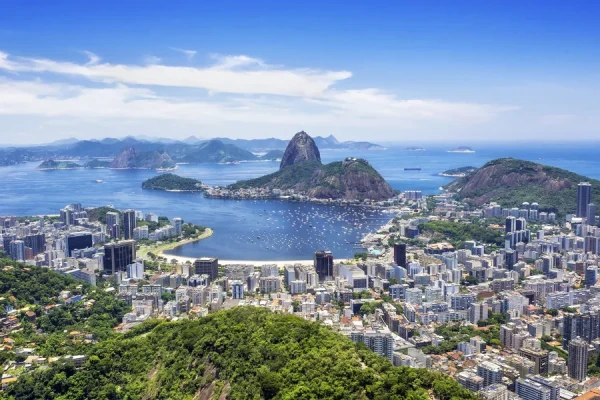
The country is characterized by overall friendliness and a complete absence of negativity towards outsiders.
69% of Brazilians believe that 2026 will be better for them compared to 2025, according to a survey published by the Datafolha institute on the front page of the Folha de Sao Paulo newspaper.
The result represents a nine percent increase in optimism compared to the previous year, as by the end of 2024, 60% of respondents expected an improvement in their personal situation in the current year.
When asked, "In your opinion, will 2026 be better, the same, or worse for you than 2025?" 16% responded that the situation will remain the same, 11% believe it will get worse, and 3% do not know how to answer.
The first thing that newcomers notice in Brazil is the overall friendliness and complete absence of negativity towards outsiders. Historically, due to numerous waves of migration, Brazil has become a true Noah's Ark racially and ethnically.
For example, there is simply no collective visual portrait of a "real Brazilian": they can be brunettes, chestnuts, or blondes, of all skin tones, with Caucasian, Asian, or African facial features. Certain ethnic types prevail in specific regions, but in general, only a lack of knowledge of Portuguese or an accent will reveal you as a foreigner.
By the way, many newcomers believe that in a popular tourist country, all locals know English or at least Spanish. Some tourists hope that knowing Spanish will help them understand Portuguese, which is also a Romance language. None of these expectations are correct.
Of course, in large cities like São Paulo, Rio de Janeiro, or Brasília, it is more likely to be able to communicate in English in hotels and popular tourist spots. Spanish is mainly spoken by the younger generation — it has become fashionable to learn it in Brazil in recent years. Some Brazilians speak a so-called Portuñol — a mixture of Portuguese and Spanish. And almost all Brazilians understand Spanish quite well. However, the opposite does not seem to work: understanding Portuguese is difficult even for native Spanish speakers. Nevertheless, even if the language barrier is insurmountable, everyone around will smile at you and try to help.
What else surprises newcomers?
Completely unfamiliar tastes, such as cashew apple and pork carpaccio, and their combinations in food.
Unexpectedly good roads, except in remote regions.
Confusion with the seasons: winter here is when it’s hot, summer is when it’s cold, and New Year’s.
Carnival. A very unique holiday on the level of the Olympic Games. (Carnivals take place in many cities in Brazil, the main one being in Rio de Janeiro.)
Strong social stratification. There are wealthy neighborhoods here, like in Europe, and poor ones, like in Africa, luxurious villas and impoverished favelas.
High prices. Contrary to stereotypes about the cheapness of Latin America, Brazil is generally quite an expensive country. This, for example, explains the fact that several generations of one family often live in one apartment.
The presence of helpers, read servants, among representatives of literally all layers of society, except for the very poor. Middle-class representatives often have several people — a cleaner, a cook, a doorman, a gardener. In apartment buildings, there are separate elevators for servants, and they cannot use the residents' elevator.
Security issues that noticeably affect everyday habits.
Cold in houses during the summer due to the lack of heating. Not because of air conditioning, but naturally: the tropical climate predominates in northern Brazil; in the south, the climate is temperate, with cool summers, and in the east, there can even be frosts.
Brazil is divided into five large regions — southern, southeastern, central-western, northern, and northeastern.
The regions are subdivided into states, totaling 26 plus the Federal District of Brasília. Each state has a certain degree of autonomy, with its own legislative and tax peculiarities.











Leave a comment