
People of various social statuses were buried there, as evidenced by the diversity of burial structures.
Archaeologists have discovered a painted Christian tomb in the necropolis of ancient Nicaea (northwestern Turkey). Although no dating artifacts have survived inside the tomb, the style of the images allows it to be dated to the 3rd century AD.
Nicaea was founded in the 4th century BC by the Macedonian king Antigonus I Monophthalmus. It was an important center during the late Roman and Byzantine periods. Nicaea was the site of two early church councils (325 and 787 AD), and in the 13th century, after the conquest of Constantinople by the Crusaders, it became the center of an independent kingdom. In 1331, the city was captured by the Ottoman Turks, who renamed it Iznik, which is its name to this day.
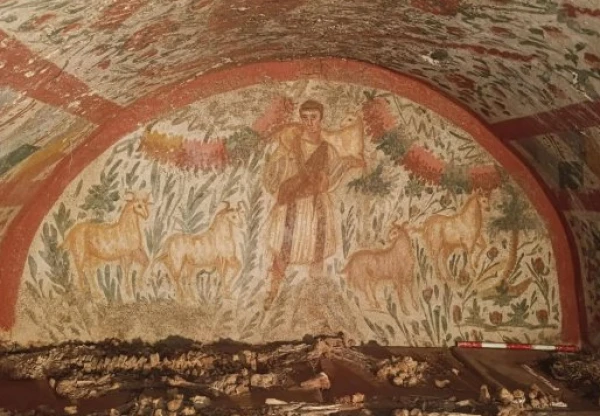
The tomb was found in the Hisar Dere necropolis, located directly behind the fortifications of the ancient city. It was used from the 2nd to the 5th century AD and is one of the largest earth burial sites in the region. People of various social statuses were buried there, as evidenced by the diversity of burial structures: from stone boxes and sarcophagi to tombs with terracotta roofs. The painted tomb was arranged underground, with a vaulted ceiling. The southern wall of the tomb was found to be destroyed, while the others have been well preserved. All surfaces, except for the floor, are covered with bright frescoes depicting flowers, birds, scrolls, and human figures.
The central place above the burial bed features an image of Christ as the Good Shepherd. The artist portrayed him as young, beardless, with a lamb on his shoulders. On either side of him stand pairs of goats, depicted against a backdrop of lush greenery.
The image of Jesus the Shepherd caring for his flock was widely used in Roman funerary art during the early Christian period. However, the newly discovered image is the oldest outside of Italy.
On the western wall of the tomb, a married couple is depicted reclining on dining couches. They are likely the "owners" of the tomb – those who were buried there. Judging by their clothing and adornments, they belonged to the aristocracy or wished to be portrayed as such.
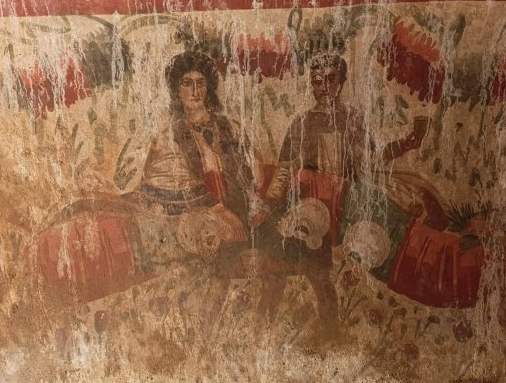
The scene of the symposium (feast) is indicative: this motif is typical of "pagan" funerary art but continues to be used in the Christian era.
















Leave a comment