
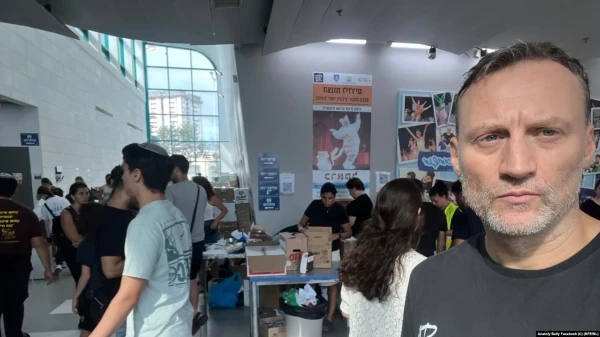
"Of course, Israel is a tough country," the man admits.
Anatoly Bely is a well-known theater and film actor, formerly a distinguished artist of Russia. He worked in Moscow at the Stanislavsky Theater, at the Chekhov Moscow Art Theater in classical repertoire (under the direction of Oleg Efremov, Adolf Shapiro, Sergey Zhenovach, Tadashi Suzuki, Janos Sasa), as well as in productions by Robert Sturua and Dmitry Krymov. Charismatic, he has played many leading roles and works wonderfully in episodes. He is actively interested in contemporary theater, having performed in plays by Mikhail Ugarov, Kirill Serebrennikov, and Vladimir Ageev. He is the author of several concert programs featuring poetry from the 20th and 21st centuries. His performances included texts for the TV channel “Dozhd”, particularly the famous poem by Zhenya Berkovich. He has narrated several audiobooks by Sasha Filipenko. He calls poetry his passion. In 2022, after the start of Russia's full-scale invasion of Ukraine, he resigned from the Moscow Art Theater and repatriated to Israel. He works at the Gesher Theater and in film. In 2024, he voiced the Russian version of Steven Spielberg's documentary film “Auschwitz”. He played the role of prosecutor Vyshinsky in Sergey Loznitsa's film “Two Prosecutors”, which opened this year's Cannes Film Festival. Our conversation is about the experience of a dramatic actor and an emigrant, about Russia and Israel.
– You moved to Israel in 2022. For you, is Israel a land of opportunities or a tough battle for a place in the sun?
– Of course, Israel is a tough country. Here, wide opportunities in large industries do not open up immediately. But if you open up to it, it opens up to you many times over. I feel this myself, knowing that I came with an open heart. I didn’t care that there are shortcomings in the bureaucratic system, that it’s hot. But I didn’t complain; I knew I needed to take root in this land because I have burned my bridges behind me. It wasn’t forced; it happened out of love. My mother, father, sister, and two brothers with their families have lived here for a long time, for 25 years. I am the last one to arrive.
– Do you observe Shabbat?
– I haven’t immersed myself in the traditions of the country to the extent that I observe Shabbat. My older sister suggested that we come to our parents for lunch every Saturday or Friday. This is our tradition, the Shabbat of our family that we observe.
– When did you find out that you are Jewish?
– In the fourth or fifth grade, I discovered it in the class journal. In the Soviet school, there was a class journal where all the students in our class were listed. And there was a column for "nationality", where I saw the three letters "Jew". I thought, what is this? I came home and asked, and they explained to me that this is our nationality. But my mom and dad were raised in the spirit of Soviet fear. They were so heavily burdened by this fear that they said, "Don’t tell anyone that you are Jewish." I kept silent, and there were no questions about it until we reached high school.
– When did you take the pseudonym Bely, although by birth you are Vaysman?
– This is a common question. In 1996. It was not dictated by anti-Semitism, but by the fact that I didn’t like the sound of my last name; it was too harsh, and I felt a mismatch between the surname and myself, my personality. I decided to translate it from German, and it turned out to be Bely, which resonates more with me. But then at the Stanislavsky Theater, they joked: "Of course, as for the poster, you are Bely, but as for the box office, you are Vaysman."
I am part of this people, and I am proud of it
Not at all in the country you thought you lived in. These questions arose sharply and quickly received an answer: I am Jewish. Why did I forget about this? Of course, it was the gene of Soviet fear, and I am squeezing this fear out of myself drop by drop. The realization that I am Jewish and that I belong here came in Israel. And in light of the huge wave of anti-Semitism in the world, you understand: where else should you be, dear friend, born in Bratslav in the Vinnytsia region, in a place where Hasidim once left a huge legacy? The spiritual connection has always been there, and here I realized that I am part of this people, and I am proud of it. While studying history, I try to learn the history of the holidays.
– What does "Jewish happiness" mean to you?
– It’s funny because in the paradigm of a Soviet person, "Jewish happiness" has a negative connotation, such a Jewish sarcasm, exactly the opposite. Family is my Jewish happiness, I would say. You live, everyone is alive and healthy, your loved ones are around. That is already happiness. This is the price of happiness, especially when rockets are flying at you. It is acutely felt in the little things. If there were peace, that would be great Jewish happiness.
– Continuing the topic of anti-Semitism: is it a universal trait of human society, or a reflection of specific historical and cultural traumas? To put it simply: why are Jews disliked?
– There must be someone to blame for all sins, personal fears, and malice. In any society, in any small group, in a school class, there is a person onto whom it is easy to offload all this. This is a centuries-old tradition; there are entire theories based on some nonsense, "they drink the blood of infants", and this: "they crucified Christ".
Culture does not save from anything
This phrase has been drilled into the dark minds of a people kept in darkness, and it was done deliberately, that "this is the enemy". There must be at least one common enemy for everyone. It so happened that it is the Jews. In this balance, we have always existed. And the great Jewish happiness is that there is Israel, a country where Jews can live in peace. I think anti-Semitism will last for a long time; it is in generations, and I don’t know how to break it. Moreover, in the propaganda of the state of Israel, we have lost the information war. We call it the Ministry of Explanation; they probably are now pulling their heads together and getting to work. Let’s hope that someday the situation will change. Although, as our existence has shown, and the previous one too, culture does not save from anything, neither from Hitler nor does it save now from this filth.






Leave a comment