
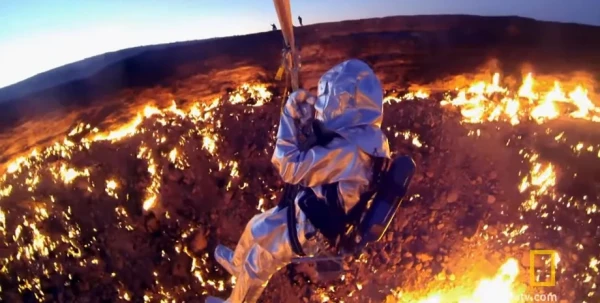
Natural gas will soon burn out, but the memorial site will remain.
Darvaza, or as it is also called in Turkmenistan "The Burning of Karakum," is a flaming crater that has been emitting natural gas since 1971. It is unbearably hot nearby, but one scientist descended into it in a special heat-resistant suit, writes Mirror.
According to one legend, Darvaza was created when Soviet geologists accidentally collapsed a gas chamber while drilling and subsequently ignited it in an attempt to localize deadly gases and prevent their spread. What engineers thought would extinguish in a few weeks has been burning for over 50 years (not surprising, considering that the country ranks fourth in the world in natural gas reserves).
The gas crater Darvaza, known as the "Gates of Hell," has been burning since 1971 and has only just begun to extinguish. It is a popular tourist destination, but only one person in history has descended into the pit where gas continuously burns and where it is deadly to be.
Notably, there are no official records of this incident in Turkmenistan, as the relevant documentation is either classified, unavailable, or missing from archives — which aligns with the country's secrecy policy. These "Gates to Hell" are aflame near the village of Darvaza, located in the heart of the Karakum Desert, and measure approximately 60–70 meters in width and 20 meters in depth.
The crater is located near the village of Darvaza and 260 km from Ashgabat. The village itself was eliminated in 2004.
This hellish pit can be seen from many kilometers away and has become one of Turkmenistan's main tourist attractions. Despite the apparent inhospitability of this flaming abyss, visitor accounts indicate that, surprisingly, signs of life can be found in the crater.
The only known case of a person descending into the crater was made by Canadian explorer George Kourounis. In November 2013, Kourounis descended to the bottom of the Darvaza gas crater with National Geographic to collect soil samples for the Extreme Microbiome Project and to explore potential signs of life in the harsh crater environment. Equipped with a special heat-resistant suit, Kourounis was able to spend about 17 minutes inside the fiery abyss.
During an exciting episode of the research, Kourounis described their mission as "the search for extraterrestrial life right here on Earth," considering that the hostile, methane-rich environment of the crater resembles the environments of some planets beyond our solar system. Indeed, they found signs of life. Kourounis's expedition discovered several types of bacteria in the soil at the bottom of the crater.
Reflecting on his experience visiting the apocalyptic "Gates of Hell," Kourounis said: "There is an incredible amount of flame raging there, as if there is a lot of fire. It burns both day and night. If you stand at the edge, you can hear the roar of the fire. The heat, if you are on the downwind side, is unbearable. Along the edges and closer to the center, there are thousands of little flames. It is a very dangerous place."
Now, after more than 50 years of fierce raging flames, it seems that the fire in the Darvaza crater is finally dying down, albeit gradually. During a press conference in June 2025, Irina Lurieva, director of the Turkmen state energy company "Turkmengaz," announced to the world that the crater is finally burning out, stating: "If previously the huge glow from the fire could be seen from several kilometers away, hence the name 'Gates of Hell,' today only a weak ignition remains."















Leave a comment