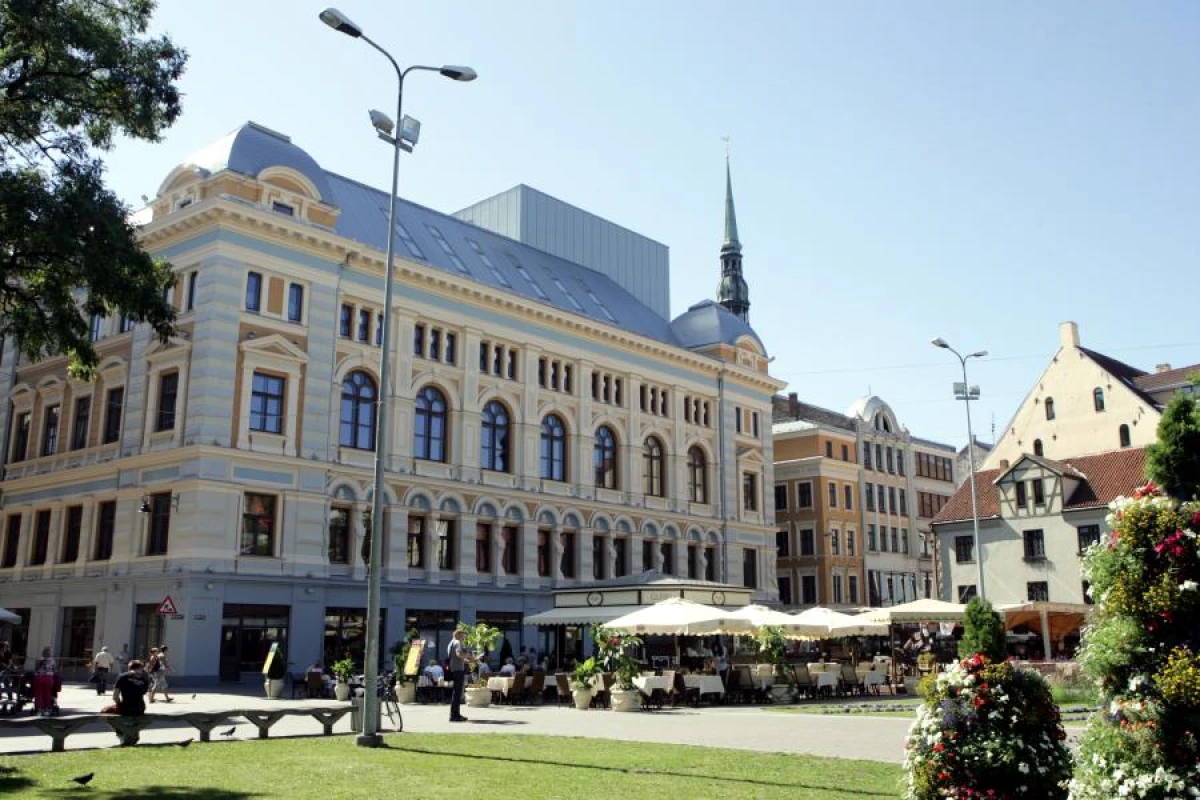
Disputes around the Mikhail Chekhov Theater in Riga continue. Activist Marcis Kulis questioned the very existence of the state Russian theater in Latvia, however, the reaction of the majority of society turned out to be quite different from what he likely expected, writes Otkrito.lv.
Bb.lv reported that in early June, Riga's Vice Mayor Edward Ratnieks addressed Culture Minister Nauris Puntulis with a demand to dismantle the Russian-language signs from the facade of the Mikhail Chekhov Riga Russian Theater. According to the politician, the presence of a large inscription in Russian contradicts the State Language Law and sends "incorrect signals to the residents of Riga."
Later, the Minister of Culture announced plans to have a "serious conversation" with the theater's management not only regarding the signs but also in connection with complaints about the use of the Russian language in the workplace.
Against this backdrop, a new round of discussion was provoked by public figure Marcis Kulis. On social media, he stated: "Enough glorifying this imperial nation. When they leave the occupied territories and repent as a nation, then we will talk again. For now, their culture is as imperial as that of the Nazi empire.
I do not believe that during World War II there would have been a London German Theater funded by the state with Schiller and Goethe. That did not exist. It did not exist," he said and suggested: "The Riga 'Russian' theater should be transformed into the Riga Ukrainian and Polish theater."
Judging by the hundreds of responses, most participants in the discussion, many of whom were Latvians, did not support the activist's position. Users particularly objected to attempts to equate classical literature and theater with the actions of contemporary politicians.
One commentator wrote: "It is very sad that Schiller, Goethe, Turgenev, Pushkin, and Chekhov are placed in the same row with today's politicians and rulers. Only people with very limited thinking can equate world classics with political figures."
Others reminded that even after the defeat of Nazi Germany, no one banned the works of Goethe, Schiller, Remarque, or Wagner. Many pointed out the historical role of the theater itself: "This theater has long traditions and high artistic value." Some suggested abandoning the national approach to culture altogether: "In theater, one can stage plays from around the world in different languages - Chekhov in Russian, Shakespeare in English, ancient Greek works in the original language. This would only enrich cultural life."
More radical proposals were also voiced. One participant in the discussion suggested creating a "Slavic theater" in Riga, where groups could perform in Ukrainian, Polish, Belarusian, and Russian. Others joked about theaters of various nations around the world, mocking the very idea of cultural division based on nationality.
A significant portion of commentators questioned why politicians' attention is focused specifically on the theater. The thought was repeatedly expressed in the discussion: "Are there really no more important problems in the country than disputes over the name of the theater and signs?" Others directly called the initiative an attempt to artificially inflame cultural conflicts against the backdrop of economic and social difficulties.
By the way, this is not the first attempt to convince the public of the need to close the theater. Earlier, an article by Juris Albert Ulmanis with the provocative question: "Is a Russian-language theater needed in Riga?" caused an uproar: dozens of people, the overwhelming majority of whom were Latvians, took to social media to defend it, stating that it is needed and loved - regardless of the language.