
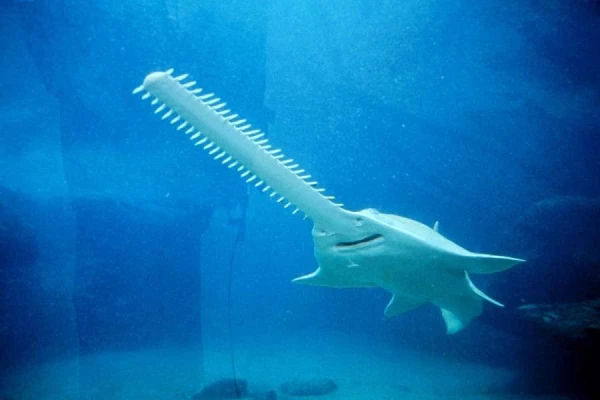
The smalltooth sawfish is an endangered species. Recently, this animal has been exhibiting unusual behavior in the waters of Florida, putting it at even greater risk.
The smalltooth sawfish (Pristis pectinata), whose jaw resembles a chainsaw, belongs to the family of sawfishes. In their natural habitat, these fish can live for several decades. On average, five adult individuals die each year, most often due to accidental capture in fishing nets.
However, this year, according to the Florida Fish and Wildlife Conservation Commission, 38 cases of mortality have already been recorded. Of these, six individuals died just in the last week.
Unusual Behavior
Since the fall of 2023, smalltooth sawfish exhibiting abnormal behavior have been observed off the coast of Florida Keys. These fish are swimming erratically in shallow waters, beaching themselves, and dying.
The total number of recorded cases exceeds 200, with such behavior observed not only in smalltooth sawfish but also in other species. This mainly occurs in Florida Keys, but reports have also come in from Miami.
What Could Be the Cause?
Local and state experts, as well as scientists, are trying to determine what is causing the spiral movement of the fish and their stranding. However, at this point, no one has a clear answer.
Water sample analysis has not revealed any significant deviations—the levels of oxygen, salinity, pH, and temperature are within normal ranges. No hazardous chemicals have been detected in the water.
Necropsies of the sawfish have not yet shown any signs of infectious pathogens.
However, some tests have indicated elevated concentrations of Gambierdiscus—marine dinoflagellates capable of producing neurotoxins. It is possible that they may be the cause of the abnormal behavior. However, further research is needed for more accurate conclusions.
The population of smalltooth sawfish has significantly declined in the second half of the 20th century due to habitat loss and incidental catch. This is why this fish became the first marine fish to receive federal protection under the Endangered Species Act in 2003.








Leave a comment