Other animals prefer to keep their distance from them.
On the shore of Bering Island, scientists found dorsal fins of orcas with tooth marks that likely belonged to their own kind. An international team of biologists gathered evidence that members of one group of orcas may hunt members of another. This discovery will help explain why these marine mammals often travel together.
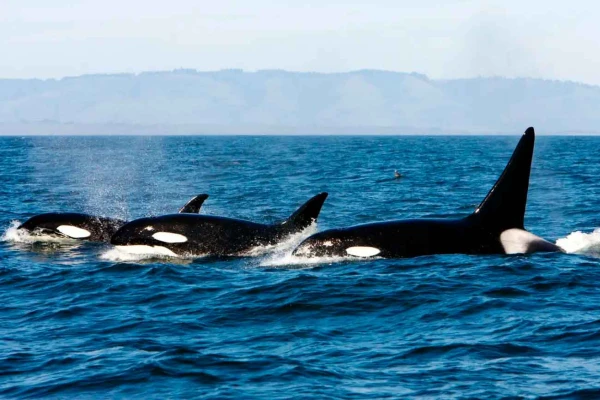
In the northern part of the Pacific Ocean, there are two ecotypes of orcas that lead completely different lifestyles: transient (Type T orcas) and resident (Type R orcas). Transient orcas, also known as Bigg's orcas, are nomadic. They gather in temporary hunting groups and attack seals, dolphins, and other whales together. Their social bonds change, they move freely, and are not tied to a single family.
Residents are different. These orcas form large clans based on maternal lineage. Calves stay with their mothers for life. Together they rest and travel. They tend to hunt more often alone, but always stay close to each other, coordinating their search for fish. After hunting, residents often share their catch with other family members, thus maintaining strong social bonds within the pod.
Scientists long believed that the two ecotypes rarely intersect. But Sergey Fomin from the Pacific Institute of Geography of the Far Eastern Branch of the Russian Academy of Sciences found evidence of violent encounters between representatives of these groups.
In 2022, on one of the beaches of Bering Island, Fomin found a dorsal fin of an orca. It was bloodied and covered in marks from foreign teeth. Two years later, in 2024, another fin with bite marks washed ashore.
Genetic testing showed that the fins belonged to resident orcas, while the tooth marks likely came from transients. Fomin's team concluded that the marine mammals fell victim to Bigg's orcas.
Fomin's colleague Olga Filatova from the University of Southern Denmark had long been trying to understand why resident orcas create such large and stable families. Usually, in toothed whales (Odontoceti), which include orcas, groups change: old acquaintances leave, new ones appear, alliances break apart and are formed anew. But resident orcas live differently—they stay with their mothers for life, even after becoming adult and independent hunters.
When the biologist learned about the two fins and the probable cannibalism, everything fell into place. She suggested that resident orcas likely band together in large groups to protect themselves from aggressive relatives. Together with Fomin and colleague Ivan Fedutin, the researcher published a scientific paper in the journal Marine Mammal Science, where she presented this hypothesis.
Orcas are apex predators in their ecosystem. They have no natural enemies among marine mammals and are rarely attacked by other animals. But there are exceptions. There are known cases where smaller pilot whales (Globicephala) forced orcas to flee by attacking as a group.
<iframe width="560" height="315" src="https://www.youtube.com/embed/QQdlEyLaeXM?si=HtDSp1BAvIWcend3" title="YouTube video player" frameborder="0" allow="accelerometer; autoplay; clipboard-write; encrypted-media; gyroscope; picture-in-picture; web-share" referrerpolicy="strict-origin-when-cross-origin" allowfullscreen></iframe>