
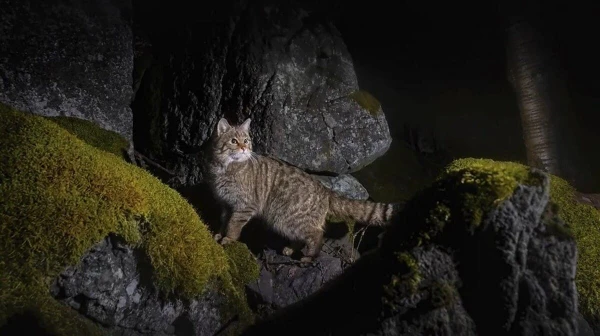
The population of the species is growing due to conservation laws enacted in the late 20th century.
For decades, the European wildcat (Felis silvestris) was considered extinct in many regions of Europe. Today, however, thanks to camera traps, naturalists, and new research methods, this 'ghost cat' has once again come to the attention of scientists — after being recorded in the forests of Europe.
According to zoologist Jarmila Kroerova from the Czech Academy of Sciences, until the 18th century, the wildcat was widely distributed throughout the country. Intense persecution and landscape changes led to its disappearance. The last reliably confirmed case dates back to 1952, when an animal was killed. It was not until 2011 that its presence was recorded again — accidentally, using a camera set up to observe lynxes.
Studying this species remains extremely challenging. Similarity to domestic cats often leads to identification errors. In Italy, expert Andrea Sforzi maintains a database of about 1,600 photographs and videos of the wildcat, collected by scientists and enthusiasts. He notes that in some areas, especially in the northern Apennines, the population of the species is growing due to conservation laws enacted in the late 20th century.
However, a serious threat remains the interbreeding with domestic cats, leading to the emergence of hybrids and increasing the risk of disease spread. Accurately determining the 'purity' of the species requires genetic analysis, which is difficult to conduct: wild cats rarely leave suitable fur for DNA. In 2025, Czech researchers achieved another important milestone — they captured a male wildcat and equipped it with a GPS collar. The data obtained showed that the range of these animals is significantly wider than previously thought, and that the wildcat is not only a forest species but also a resident of a mosaic landscape that includes forests, meadows, and pastures.
The return of this species is a story at the intersection of science, photography, and social change. As people leave mountainous areas, nature regains space. And quietly, almost imperceptibly, this small creature is returning to the forests of Europe.












Leave a comment