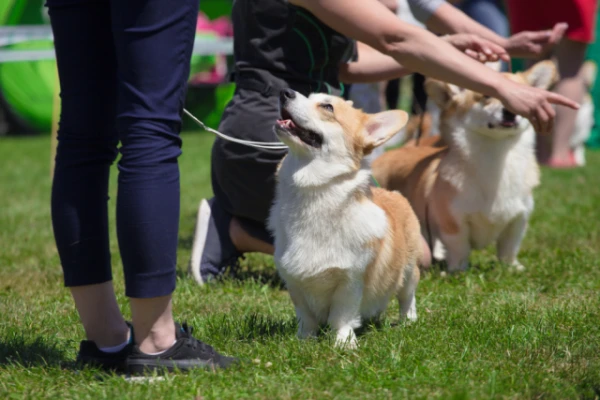
The way the brain processes information about space, location, and distance applicable to a specific object is called spatial bias. This is demonstrated by the difference in response between a dog and a child when they are pointed to where a toy or treat is located.
According to neurobiologist Ivaylo Iotchev from Budapest, a child interprets a gesture as pointing specifically to an object from an early age, while a dog sees it as a directional signal.
A new study has shown that some dogs can overcome spatial bias when solving non-trivial tasks.
Two behavioral models were tested involving 82 pet dogs of various breeds and sizes. In the first case, the animal was given no more than 50 attempts to understand whether a treat was placed on the right or left side of a plate. In the second case, white round and black square dishes were used. Both plates were always placed next to each other, but the treat was only on one. Each time, the plate was chosen randomly.
It turned out that dogs learned faster when the treat was placed to the right or left of the plate rather than on it. The animal recognized the specific location more quickly than the properties of the object, such as color and shape.
To determine the source of spatial bias, the team decided to establish how the visual and cognitive abilities of different animals differ. The length of a dog's head correlates with its vision: breeds with shorter heads have vision similar to humans, sharper and more focused.
In a series of tests on memory, attention, and persistence, it was found that dogs that see fine details better have less spatial bias.
Experts claim that in human children, the described bias gradually diminishes as intelligence develops. A similar principle has proven possible for some "smart" dog breeds.