
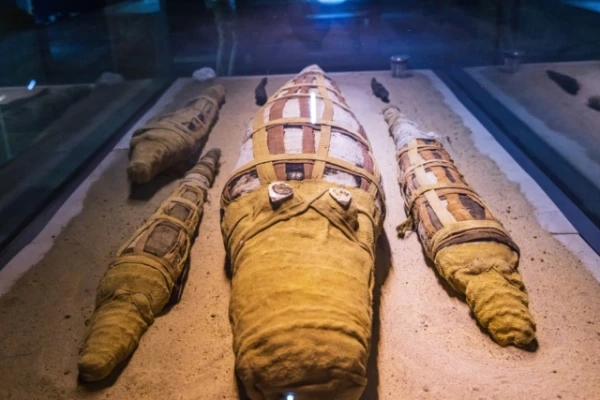
Modern technology has allowed scientists to look inside an Egyptian crocodile mummy without unwrapping it, revealing a stunning find over 2000 years old—the last meal of the reptile.
Using computed tomography (CT) at the Birmingham Museum, researchers identified undigested fish in the animal's stomach, still attached to a bronze fishing hook. This indicates that the crocodile was caught and then very quickly, before the body began to decompose, mummified for ritual purposes. The presence of the hook also confirms the hunting methods described by the ancient historian Herodotus, in which crocodiles were lured with a hook baited with pork meat.
Importantly, during the embalming process, the animal's internal organs were not removed, as was often done with human mummies. This allowed for the preservation of a unique "time capsule" that has survived to this day.
Of additional interest are the gastroliths found in the intestines—stones that reptiles swallow to aid digestion and regulate buoyancy. Some of them had not yet settled in the stomach, which may also indicate a sudden death. The mummy likely belongs to a Nile crocodile and dates back to the period of active animal mummification practices (approximately 2000–3000 years ago). It was created as a votive offering to the god Sobek, who embodied the power of water and fertility.
The study vividly demonstrates how non-invasive methods—specifically, CT scanning and subsequent 3D modeling—allow for the extraction of valuable data about ancient artifacts without damaging them, and open new pages in understanding religious practices and human interaction with nature in Ancient Egypt.













Leave a comment