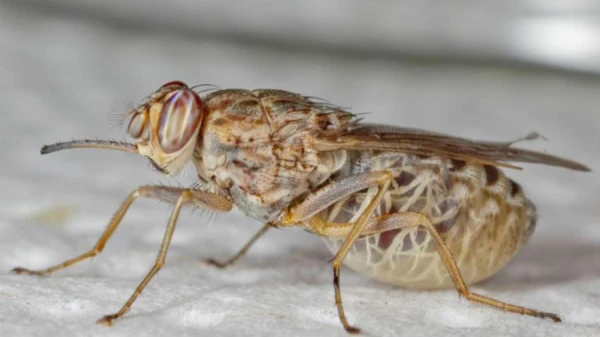
These buzzing insects not only cause irritation but can also pose health risks. If you try to swat them, it turns out to be quite a difficult task—flies are almost always faster than you. What is their secret?
Catching a fly is no easy task. This is not only due to the excellent reflexes of these insects but also to their modified hind wings.
Flies have numerous adaptations that increase their speed, maneuverability, and reaction, allowing them to evade even the fastest strikes. However, one of these adaptations plays a key role in the ability of flies to avoid swats from fly swatters or newspapers.
House flies (Musca domestica) belong to the order Diptera, or true flies. These insects have modified hind wings that have transformed into tiny stick-like structures with a small knob at the end, called halteres. Their vibrations help flies stabilize their bodies during flight, controlling rotation and correcting wing movements.
Flies from the Calyptratae group, which includes house flies, also use halteres during movement. Until recently, scientists did not know what purpose this served. In a study published in the journal Proceedings of the Royal Society B: Biological Sciences, the authors examined Calyptratae flies to determine how the oscillations of halteres affect their takeoff speed.
Using high-speed cameras that recorded tethered and free laboratory flies during takeoff, the scientists captured video at a rate of up to 3000 frames per second. The results showed that Calyptratae flies take off about five times faster than other species: they require only 7 milliseconds for takeoff—one wingbeat. None of the studied flies with halteres took longer than 14 milliseconds to take off, while insects without these structures required an average of 39 milliseconds to lift off the ground.
Additionally, flies have excellent vision, allowing them to react to threats long before they appear. About 200 milliseconds before takeoff, fruit flies can detect impending danger to calculate the moment to jump and determine the flight direction that will help them hide in a safe place.