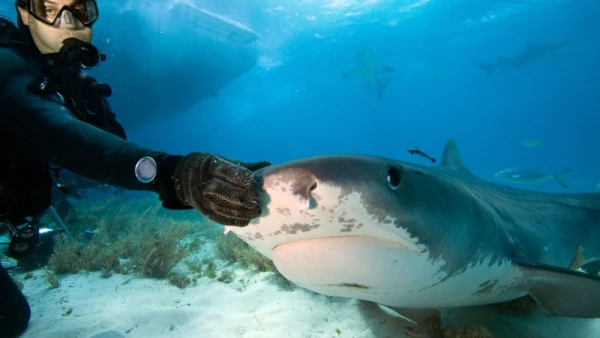
To treat a shark, one must first understand what being healthy means for it.
Achieving this is not so simple — after all, the 'gold standard' of health is a wild animal living in its natural environment. But how do you obtain benchmark indicators for a shark? An international group of scientists from the USA and Ecuador sought the answer to this question.
Their research, published in the Journal of Zoology and Wildlife Medicine, establishes reference blood values for young blacktip sharks inhabiting the Galapagos Islands for the first time. This data — like a table of norms for a doctor — will allow veterinarians to diagnose and treat diseases in sharks more accurately.
However, obtaining these samples was no easy task. The scientists worked in the protected area of the Galapagos Islands, in shallow lagoons where young sharks grow. The team waded into the water up to their waists and created semicircular enclosures using nets. Sharks were briefly removed from the water to take measurements and draw blood.
"These sharks were probably only two to three years old, and they were usually less than a meter long," says Associate Professor Olivia Petritz, the study's author. "But even in this case, it took several people in thick gloves to handle one shark, protecting against its sharp scales."
The second problem arose during the analysis of the samples. It turned out that shark blood cannot be tested on standard medical analyzers.
"Sharks have a completely different physiology because they have to live in saltwater," explains Petritz. "For example, the normal blood urea nitrogen level in humans is between six and 24 units. In sharks, this figure exceeds 1000. Standard analyzers are simply not designed for such values."
The samples had to be transported to a specialized laboratory. The results confirmed that the norms for sharks differ significantly not only from humans but also among different species. For instance, blacktip sharks had more leukocytes than sand sharks but lower levels of certain enzymes and glucose compared to Atlantic sharpnose sharks and hammerhead sharks.
"Studying only one species is like establishing health standards for dogs based on foxes," emphasizes Olivia Petritz.
This work is important not only for veterinarians working in aquariums but also for the protection of sharks in the wild.