
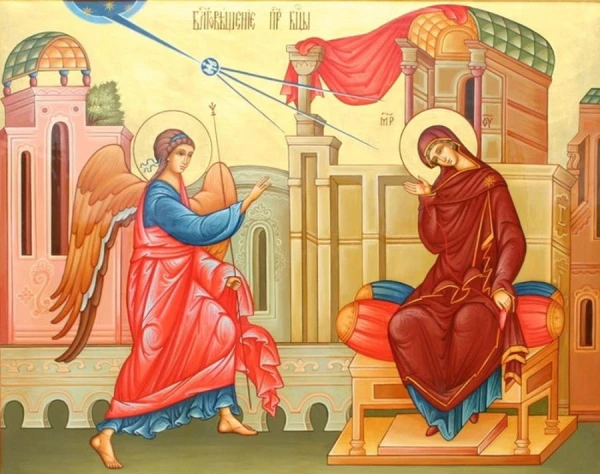
The Annunciation of the Most Holy Theotokos is one of the Twelve Great Feasts in the Orthodox tradition. It is dedicated to the significant moment when the Most Holy Virgin Mary learned of her destiny to become the Mother of the Savior. Every year, this bright event is celebrated on April 7.
The Annunciation of the Most Holy Theotokos is a significant event in Orthodoxy, celebrated on a strictly established date. This day falls exactly nine months before the Nativity of Christ.
On this holiday, believers remember how the Archangel Gabriel appeared to the Virgin Mary with the joyful news that she would give birth to a Son: “He will be great and will be called the Son of the Most High.”
The full name of the holiday is the Annunciation of the Most Holy Lady, our Theotokos and Ever-Virgin Mary. Last year, the holiday fell on a Friday, and in 2024, it will be celebrated on a Sunday.
The history of the Annunciation of the Most Holy Theotokos
This greatest event in the lives of Orthodox Christians has been celebrated since the 3rd century. Initially, there were several names for the holiday, such as “Day of Greeting,” “Greeting of Mary,” and “Conception of Christ,” but they did not take hold. Only in the 7th century did the name we know today become established.
Traditions of the Twelve Great Feasts
The festive events dedicated to the Annunciation of the Most Holy Theotokos begin on the eve, April 6. In the evening, the Great Compline is held, preceding the All-Night Vigil, during which the clergy read the Liturgy of St. John Chrysostom.
The morning of the next day begins with a festive liturgy. The clergy don blue vestments, symbolizing the Most Holy Theotokos, and tell the parishioners about the significance of this great event. The solemn canons sung in the churches were written as early as the 8th century.
Many beautiful traditions are associated with the Annunciation. One of them is the release of birds, symbolizing the desire of every creation of God for freedom. In ancient times, birds were sold before the holiday so that believers could set them free on this day.
Annunciation: are there any dietary relaxations allowed?
On the Annunciation of the Most Holy Theotokos, some relaxations in diet are permitted, but this is not always the case. If the holiday does not coincide with Holy Week before Easter (in 2024 it will begin on April 29 and end on May 4), those fasting are allowed to eat fish, pastries with potatoes or cabbage, as well as prosphora, which are prepared in advance and blessed during the services.
Often, the Annunciation falls during Great Lent, and it is celebrated either during Great Lent or Holy Week, although this is rare. Sometimes the holiday coincides with Bright Week.
Annunciation: what can be done on the Twelve Great Feast?
In the past, the morning of the Annunciation began with visits to churches. Devout people still adhere to traditions that have existed for centuries. It should be noted that on this day, even those who rarely attend services come to church.
Our ancestors had a tradition of sharing the joyful news with relatives and acquaintances. Earlier, Orthodox Christians would turn to the Most Holy Theotokos for a good harvest, and seeds were blessed in churches.
One can turn to the Mother of God for advice on raising children, as well as ask for health for oneself and loved ones. The Most Holy Theotokos helps to strengthen faith in God and in oneself.
Since ancient times, it has been customary to welcome travelers, support people in difficult situations, and help the poor on the Annunciation.
Annunciation: about folk signs
There are many good signs associated with storks. Our ancestors believed that seeing these birds on such an important day brings good luck. Such people will be fortunate in all their endeavors.
Stork nests on roofs were also considered a good sign: it meant that families living in those houses would not have domestic problems. For childless couples, this could herald an addition to the family.
On April 7 (March 25 in the old style), our ancestors closely monitored the weather. If it rained on the Annunciation, it foretold a good harvest of grains in the summer.
A warm night on the Annunciation promised a warm spring. If by this time birch trees had small leaves, the summer would be sunny and warm.
The weather on the day of the Annunciation will indicate what nature has prepared for Easter.
There is a sign about snow: if it has not melted by April 7, the autumn will be warm and comfortable. If there are many puddles on this day, there will be many mushrooms in the autumn.
Annunciation: what should not be done
One of the main prohibitions is fuss and worries. The great holiday should be spent differently, focusing on its spiritual significance rather than on domestic problems.
There is a belief that on the Annunciation, nothing should be done, as reflected in the saying: “On the Annunciation, the bird does not build a nest, the maiden does not braid her hair.”
In fact, this church holiday should be dedicated not to idleness, but to God. Believers are encouraged to visit the church, light candles, pray, and only then engage in other activities.
There is often a question about visiting cemeteries. There are no prohibitions: it is permissible and necessary to remember deceased relatives. On the Annunciation, clergy advise bringing children along, but it is better to tidy up the cemeteries on other days.
There are also other signs not related to church traditions. For example, people believe that on the Annunciation, one should not lend money, as this will worsen the financial situation of the creditors and will not help the borrowers.
On this day, it is also not advisable to quarrel, gossip, or be envious, otherwise the year will be filled with conflicts.














Leave a comment