
Useful tips from leading experts for gardeners and vegetable growers.
Broken Branches of Old Apple and Pear Trees
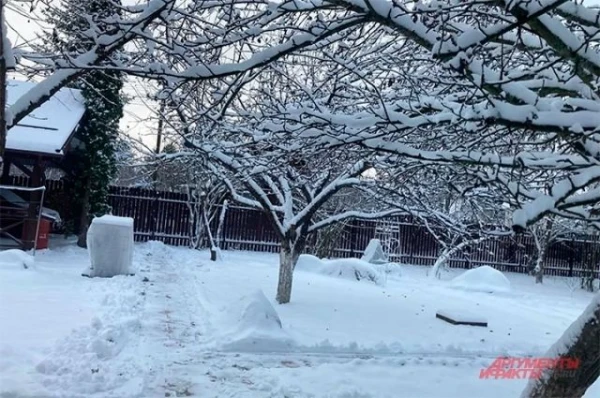
A common complaint after recent snowfalls is that branches of old apple, pear, and other fruit trees have broken. Gardener Tatiana Svetlaya explains what the course of action should be.
— In the case of a partial break, when the branch is still holding but there is a visible fracture, it is better not to try to pull it off immediately. Place a support under the damaged area — a slat, a thick stick, or a special support — and secure the break with a soft tape, bandage, or rope in several places. An important condition is to avoid tightening it tightly with rigid materials; use a soft pad to avoid crushing the bark. If the branch is seriously damaged or completely torn off, it should be removed. Pruning is done with a sharp pruner for thin branches or a saw for larger ones — the cut should be made close to the growth ring, leaving a smooth surface without “stubs” that hinder healing. For large skeletal branches, a three-step technique is used: first, a cut is made from the bottom, then from the top a little further, and finally a cut at the base — this prevents the bark from tearing. After pruning, the cut area is carefully cleaned of any peeling bark.
Do not break branches by hand — this often damages the tissue more severely and increases the risk of infection. It is also important to disinfect tools between treating different trees to avoid spreading diseases.
In spring, when the snow begins to melt and new signs of burns or cracks appear, inspect again the areas that were treated in winter. Sometimes hidden damage reveals itself later and additional sanitary pruning will be required.
Soil Preparation for Seedlings
Agronomist and biologist Denis Terentyev explained how to do this correctly.
“If the soil was prepared in advance and has frozen, it can be brought indoors for gradual warming,” the expert says. “If there is no stock of soil, you can either purchase ready-made mixtures or gather soil during thaws, for example, from soil mounds or old molehills.”
Any soil requires treatment, the biologist reminds. There are many methods of disinfection, but one of the simplest and most effective is based on alternating heat and cold. The soil is brought indoors, moistened with warm water, and allowed for weed seeds to germinate and pests to awaken, if they are present. After that, the soil is taken back out into the frost. This freezing destroys most of the unwanted vegetation and harmful organisms.
“A useful addition to the soil mixture is wood ash,” advises Denis Terentyev. “It serves as a preventive measure against damping-off disease but requires moderation, as it alkalizes the soil. For seedlings of most vegetables, one cup of ash per bucket of soil is sufficient. Adding ground eggshells also has a good effect, as it improves soil structure and provides plants with calcium.”









Leave a comment