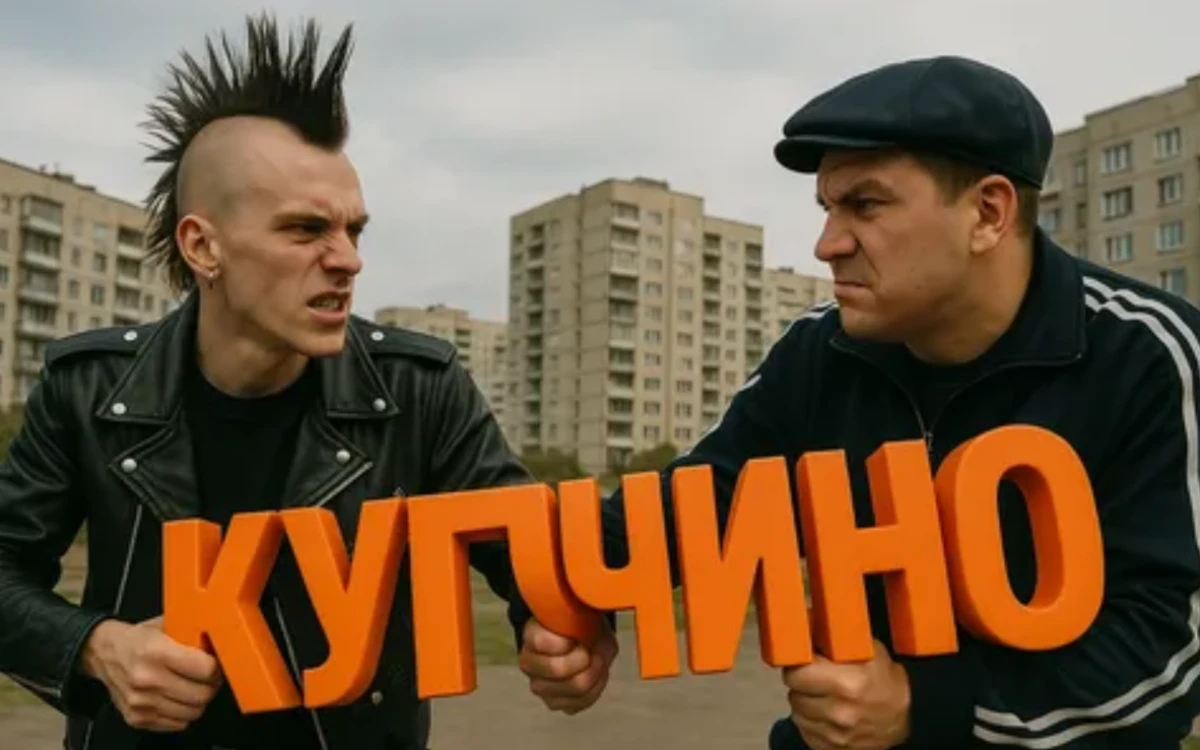
The highest level of crime in the 1990s was in the historical districts.
"Such an attitude is humiliating," says local historian and Kupchino native Marina Pavlyuchenko, who is fighting the myth of the most dangerous area of St. Petersburg.
From the assassination attempt on Vladimir Kumarin to the old lady dismemberer Baba Yaga — the lecture on Kupchino ends with statistics that show it is not a "gopnik district" and not even a leader in crime rates, but an ordinary green sleeping area.
— Marina, you write about landscaping and architecture in your blog, but how did you get into the criminal topic?
— If you search for something about Kupchino on the Internet, the first results are popular videos where the host rolls their eyes and says: "Kupchino is the scariest district of Leningrad. How can anyone live here?" This image was likely formed in the 80s and 90s when life in the country was generally unstable. This myth is still being played upon.
There are a lot of memes, and it seems funny, but when someone seriously confronts you about being from Kupchino, it’s very annoying. Even in university, I was told: "Oh, she’s from Kupchino, what could she possibly know?" Such an attitude is humiliating; it is unfair. I come from a normal, educated family.
Kupchino was created as a territory for relocating residents from communal apartments in the center. The district was built from scratch according to a plan in the 60s and 70s. There wasn’t much infrastructure, but there was already a metro not too far away and a supermarket called "Yuzhny." This was considered quite chic because many had to travel far for groceries. My family moved from Svechny Lane. Our neighbors were also from the center.
— Tell us about your childhood and youth. Were there any clashes between teenagers at school or on the street?
— We used to hang out in abandoned buildings, on concrete playgrounds, and build huts. A normal childhood. It wasn’t like you entered a yard and got beaten up for being from another yard. Although we did have divisions by yards, like many places in the 90s. There were yards called "Crocodile," "Square," "Kingdom," "Graves," "Crosses." Maybe older boys fought, but not in the way it’s shown in the film "The Word of a Guy." No one instilled fear in the district. I asked my mom, and she said: "I never saw that."
— Still, the district is heterogeneous. Are there dangerous places in it?
— I can point out two spots that still look not very good. In Alpiysky Lane, it’s an older area. Perhaps people were relocated there from the Ligovskaya slums. And on Kupchinskaya Street, there is a bottle recycling point, but also a police station nearby.
— Billy Novik, who grew up in Kupchino, said that local gopniks "harassed" him.
— That could have happened because he identified himself with rock culture. Back then, everyone was divided into subcultures. I didn’t see any outright clashes. Maybe somewhere, of course, someone hit someone. That’s not impossible, but I think it happened in any district because, in general, the subcultural theme was very developed at that time.
— If we return to your lecture, tell us where you got your information and how you chose the cases you would discuss?
— I have been collecting information for a long time. I saw two stories in the program "Investigation Led By" with Leonid Kanievsky. They were well analyzed, with photographs and addresses. I found the third case when I was preparing a report for a lecture on the architecture of dormitories. We have dormitories in the area with quite experimental, modernist architecture. They were planned as homes of the future, where people would live happily, unburdened by everyday life.
One of these buildings is located at 21 Zagreb Boulevard. A double murder occurred there. A businessman arranged a meeting with his "roof" in a café in this building, a shootout happened, and the killer was arrested 30 years later.
On Turku Street, there was an apartment of criminal authority Vladimir Kumarin, and an assassination attempt was made on him on this street. And the most "interesting" case is the maniac Tamara Samsonova, a crazy woman, Baba Yaga, as she was called.
At the end of the lecture, I present crime statistics from the 1980s to the 1990s by types of districts. It turns out that during this time, the highest crime rate was in the historical center. These are the Central, Admiralty, and Petrograd districts. An elevated level was in transitional districts — Kalininsky, Vyborgsky, and Moskovsky, where organized crime groups operated. There was trade, casinos — infrastructure for them. The average crime rate was recorded in sleeping areas, which is exactly Kupchino.
Here, the residents are mostly families, and therefore domestic crime predominates; there are actually not many high-profile cases. And even if you look at modern crime statistics, Kupchino is not among the leaders.
— If we discard the myth: Kupchino is the most dangerous district, what is it really like?
— Green, comfortable, spacious, free. There is a lot of space and air here. It seems to me that it is a district that combines the city with a piece of suburban life. Until it got too dense. I hope that doesn’t happen. A district with its own legend, its local patriotism. Therefore, coming here, one can immerse oneself in the local scene.
Was it gopnik? You could say the whole city was, because the 90s were, in principle, the time of gopniks and bandits. Now times have changed. Kupchino is a district for those who appreciate the space around them, not just a new modern apartment and a closed rubber yard. For those who want to breathe fresh air, see greenery, lakes, sit on a bench next to a tree, have a picnic, go out and lie on the grass next to the house during lunch.