The collision of nine vehicles — the accident that occurred over the weekend near Ķekava became one of the largest in recent years.
Although initial versions suggest that the cause of the accident was particularly dense fog, one eyewitness, in a conversation with the portal “tv3.lv”, proposed an alternative explanation for its occurrence. In his opinion, visibility could have significantly worsened due to warm steam emanating from nearby poultry houses, which condensed in severe frost and calm conditions, creating an almost impenetrable haze.
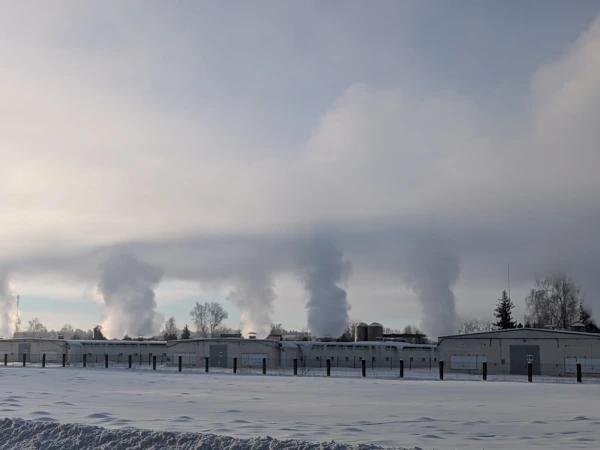
The eyewitness told the portal “tv3.lv” that on Sunday morning he left Ķekava, and his route passed by the poultry factory buildings. At that moment, the air temperature was around -20 degrees, and an impressive sight opened up from the poultry houses — clouds of steam rising above the heating pipes. The observed phenomenon also worsened visibility on the road he was traveling on, which is why the driver puts forward his version of the causes of the fog.
"It’s a coincidence, the factory is not to blame! I was on my way, it was around nine in the morning. I started from Ķekava, the accident had just happened. I passed by [note: the factory], took a photo. My pictures were taken about a kilometer from the site, but they have poultry houses even closer. Inside the poultry houses, it’s warm with the chickens. Warm, humid air rises, condenses, and there was no wind at all that morning. All this fog was lying there. I drove past, and at one point even told my passenger that he needed to get out and walk in front of the car because nothing was visible beyond two meters. This lasted for about a hundred meters," the driver recounts.
The portal “tv3.lv” contacted the meteorological service and the company “Ķekava Foods” to find out if the eyewitness's version of the fog's causes is plausible.
The company explained that during the process of raising poultry, warm ventilation air is released from the premises, which can condense at low temperatures and in calm conditions, and can be observed for some time as condensation fog over the company's territory.
"In conditions of calm, low temperature, and high atmospheric pressure, this condensation fog disperses over the company's territory or nearby. The specific location of the accident is about one kilometer from our poultry houses, and the likelihood of such condensation fog spreading over such distances is unlikely," noted “Ķekava Foods.”
The Latvian Centre for Environment, Geology and Meteorology (LCEGM) has no measurements of air pollution near the poultry houses in Ķekava, so the situation can only be commented on based on the eyewitness's description and the images shown in the photographs.
"The photographs show a typical situation of temperature inversion. An inversion is a process where a 'dome' of warm air covers a relatively large area and prevents the lower layers of air from rising, while weak winds or calm prevail. As a result, fog formed from the condensation of warm steam accumulates at the ground level, mixing with air pollution if it is created nearby, for example, by heating systems or vehicle exhausts. As the inversion weakens or the speed and direction of the wind change, the fog and pollution pressed to the ground begin to disperse," explained Iveta Indrikson, head of the monitoring department at LCEGM.
For her part, Kristiana Papa, head of the climate and forecasting department, noted: "Part of it is already understood correctly — most likely, a lot of water vapor and warm air is coming out of these cooling towers or pipes, which in such cold weather condenses very quickly when it enters the atmosphere."
The expert explained that during this cold period, including February 15, a very strong inversion was observed in the lower layers of the atmosphere — a state in which the temperature at the ground level is lower than in the higher layers of the atmosphere, making vertical mixing of air difficult, and emissions from pipes are pressed to the ground. Weak winds contribute to this process.
"In response to the question — yes, it is possible that the condensate is pressed almost to the very surface of the ground and looks like fog. Visually, this is additionally enhanced by the low angle of the sun in the morning hours. There is no meteorological station there, but the estimated wind speed in the morning could have been 1–2 meters per second, with temperatures ranging from -20 to -25 degrees," added Papa.
As reported, in some places in Latvia, a nearly impenetrable fog formed on Sunday morning. Near Ķekava, this natural phenomenon caused a serious traffic accident involving nine vehicles. Traffic was blocked at the accident site for nearly a day to eliminate the threat to residents.