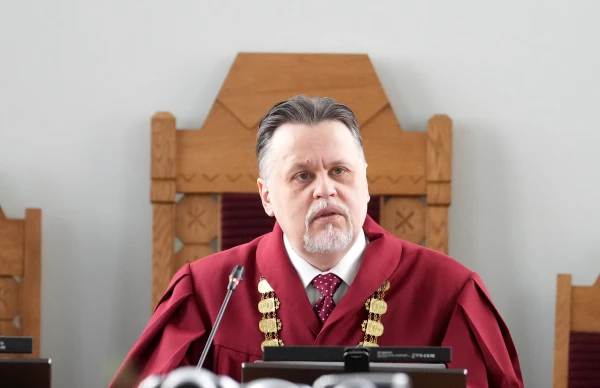
Among those convicted in the criminal case regarding the tragedy in Zolitūde, there are no entrepreneurs; only one person has been sentenced. Society is dissatisfied. In response to the question of why the courts make such decisions, the Chairman of the Supreme Court and head of the Justice Council, Aigars Strupišs, answered in the series "nra.lv TV conversations."
Strupišs emphasized that the court evaluates the evidence and must establish who is guilty, and if guilt is not proven, then a person cannot be convicted.
"From the outside, not seeing the case and not familiarizing myself with the evidence, it is certainly easy to say: 'Look, 54 dead. How can it be that only one is guilty?' It may be, or it may not be. I don’t know, I wasn’t involved in the process," said Strupišs.
"What is the alternative? To return to the laws of Hammurabi, when, if, say, a house built by a builder collapses and kills a resident's son, then the builder's son is also killed? An eye for an eye. Is that what we aspire to? 54 dead means 54 guilty?" Strupišs posed a rhetorical question.
In his opinion, there is an established process, there is evidence. And then it is a question of what investigators can gather, on the basis of which prosecutors can bring charges, and the court evaluates everything that proves the guilt of each specific defendant.
The Chairman of the Supreme Court acknowledged that people throughout history have thirsted for blood — on an individual emotional level, a person seeks not justice but revenge. But, unfortunately, it does not work that way, and that is why in modern countries the rule of law operates, not a lynch mob, Strupišs added.