
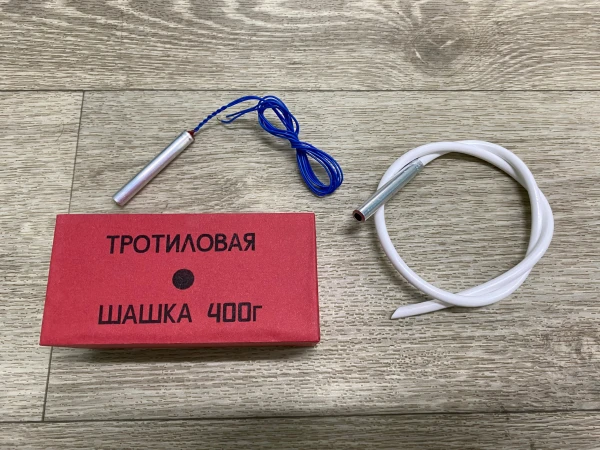
Considering the appeal of the criminal case regarding the possession of explosives (TNT) and preparation for terrorist acts, the Riga District Court sentenced Marat A. to four years in prison and one year of probation supervision on December 11, reported Latvian Television.
About a year ago, the State Security Service (SSS) transferred a case to the prosecutor's office for criminal prosecution against a citizen of Latvia on suspicion of preparing terrorist attacks and promoting terrorism.
The service established that this person systematically engaged in public glorification and justification of terrorism on the Telegram platform, as well as the dissemination of materials glorifying, justifying, and calling for terrorism.
The SSS detained Marat A. in May 2024 on suspicion of gathering instructions and self-educating for committing terrorist attacks. During a search of his home, a glass bottle containing sulfuric acid and a block of TNT were found.
The accused claimed during the pre-trial investigation that he found the TNT in the forest. An examination conducted during the investigation showed that the explosive substance was obtained from RPG ammunition — reactive anti-tank grenade launchers.
When the case was heard in the first instance at the Riga City Court, Marat A. admitted to the illegal possession of explosives and expressed remorse for it, but denied that he had trained to commit terrorist acts. Nevertheless, the first-instance court found him guilty on both counts of the Criminal Law, after which he appealed the verdict.
The prosecutor's office also filed an appeal. According to the prosecution, the collected evidence indicates that Marat A. was interested not just in Islam as a religion, but in terrorist groups, including the Islamic State.
On his mobile phone, from late 2023 to spring 2024, Marat A. downloaded at least six materials with detailed instructions on committing terrorist acts. He stored hundreds of images and videos featuring Islamist militants and propaganda on his phone and laptop.
The accused actively corresponded in extremist groups on the Telegram platform. As prosecutor Martins Jansons stated in court, this correspondence shows that Marat A. contacted a representative of an armed group in Africa, urging them to join the jihadists.
The prosecution argued that Marat A. was likely engaged in so-called "information jihad," meaning he attempted to persuade people to join the "caliphate," threatened with the wrath of Allah, and provided advice on how to act covertly in urban environments and hide traces on the internet.
The accused's lawyer, Ingus Strautmanis, emphasized in court that he considered the evidence of guilt insufficient and that a person should not be punished for an interest in Islam as such.
The accused himself did not take the opportunity to testify. In his final statement, he again requested leniency for the possession of explosives and acquittal on the charge of training for terrorism. An expert involved in the case assessed the materials and concluded that Marat A. was at the second stage of radicalization. According to this classification, practical actions could follow at the next stage.
Marat A. studied at one of the schools in Imanta, where he is remembered as an active teenager. In turn, the prosecutor claims that this person was withdrawn, spent most of his time at home, and mainly communicated with others online.
Since 2019, nine criminal proceedings related to terrorism have been initiated in Latvia, including five in the last two years, reported Latvian Television.






Leave a comment