
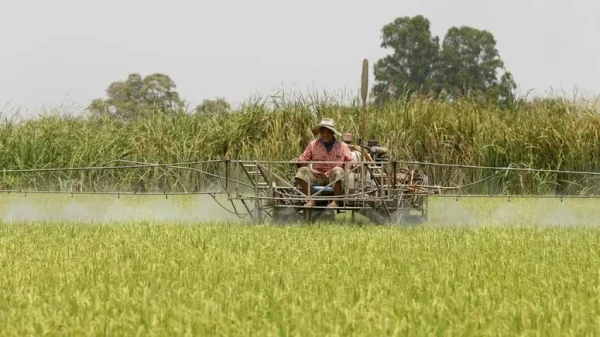
The loss of such a share of mineral fertilizers will lead to a decrease in yields.
The halt of commercial shipping in the Strait of Hormuz has led to a chain of severe consequences for global markets. In particular, the raw materials for the production of nitrogen fertilizers, primarily ammonia and sulfur, have sharply increased in price. According to estimates from international organizations, this threatens a food crisis in countries like India and Bangladesh. In this situation, Russia, being one of the largest global exporters of fertilizers, is more likely to be a beneficiary rather than a victim.
The rising logistics costs, increased insurance, and supply disruptions are already hitting the food market hard, notes The Guardian, Financial Times, Reuters, and other Western media. After Iran closed the Strait of Hormuz, prices for nitrogen additives rose by 30%, as supplies of LNG from Qatar, which serves as the main raw material for their production, effectively came to a standstill. As a result, in India, for example, many urea production facilities either completely halted operations or significantly reduced their output. The agriculture of the country with a population of 1.4 billion people critically depends on fertilizers: their shortage creates heightened risks of reduced yields of wheat, rice, and other staple crops, which means a spike in food prices.
In Europe, about half of the nitrogen fertilizer production facilities are either halted or operating at minimal capacity. For instance, the Norwegian company Yara has cut ammonia production by 60%. The global situation is exacerbated by the fact that the disruptions coincide with the preparation period for the spring planting season: there is virtually no time left to find alternative suppliers. According to Reuters, for many farmers in the U.S. and Canada, fertilizers are becoming unaffordable due to skyrocketing prices. Overall, the most vulnerable countries are in Southeast Asia, including India, Pakistan, and Thailand, where supplies from the Persian Gulf region account for more than a quarter of urea imports, a key nitrogen product.
To date, Europe, Russia, and China are the top three producers of nitrogen fertilizers. Moreover, Russian supplies (particularly to Brazil, India, the U.S., and EU countries) do not go through the Strait of Hormuz, which in the current conditions appears to be a key competitive advantage.
Alexey Zubets, director of the Center for Social Economy Research (Moscow):
"I do not share the alarmist sentiment expressed in the Western press. The nitrogen fertilizer market, which is produced from ammonia, has suffered by about 20-30%, no more. Undoubtedly, the loss of such a share will lead to a decrease in yields in 2027, but the main volume of nitrogen fertilizers for the current planting campaign was purchased by the country several months before it began. That is, even before March. Moreover, there is practically a year's supply of wheat in elevators around the world. Accordingly, there will be no tragic consequences for agriculture and end consumers in the Northern Hemisphere this year. Also, all discussions about a food crisis, about hunger that is supposedly coming in 2027-2028 in Africa and several other regions of the planet are greatly exaggerated.
As for Russia, one of the largest global producers of fertilizers, there is a high likelihood that the demand for its products will only grow. Especially since we are not talking about a sanctioned product, which is the easiest to trade, including with the West. The domestic chemical complex can earn quite a decent amount of money from this.











Leave a comment