
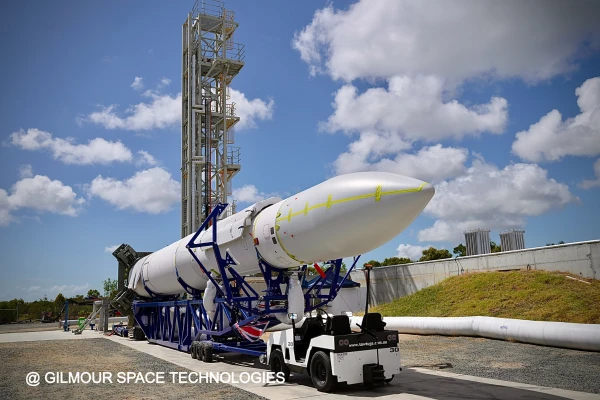
The business is designed for launching small satellites and payloads weighing up to 300 kilograms.
Australian startup Gilmour Space Technologies aims to carve out its niche in the global space launch market, Nikkei Asia reports. The company believes that without its own launch infrastructure, Australia may face technological backwardness: the demand for satellite launches is growing, and the number of those wishing to send cargo into space already exceeds the number of available launches, so spots on commercial rockets often need to be booked two to three years in advance.
Satellites have long become an integral part of modern infrastructure: they provide internet, navigation, and Earth observation. They are used to track fires and floods, monitor ship movements, and collect data over large areas. Low Earth orbit satellites typically operate for 5–7 years, after which they gradually deorbit and require replacement, so the demand for new launches remains quite stable.
In this regard, the founder of Gilmour Space Technologies, Adam Gilmour, stated that Australia needs to invest more in the industry to avoid technological backwardness. "Having our own launch infrastructure is important because getting on a rocket is very difficult right now, and the situation is only getting worse. The wait time for a satellite launch is already up to three years," he said in an interview with Nikkei, explaining that without its own rocket, Australia is forced to rely on foreign operators and wait for available slots with overseas launch companies.
Gilmour Space Technologies was founded in 2013, and two years later began developing its own rocket. In January 2026, its valuation exceeded $704 million after raising over $140 million in investments.
The latest investments will be directed towards refining the orbital rocket Eris. In July, it launched for the first time from Australian territory. The 23-meter tall rocket lifted off from the Bowen Orbital Spaceport in Queensland and was in flight for 14 seconds.
The company considers the result normal for a first launch. Sales director David Jervis noted that initial tests are rarely completely successful: "Some rockets flew for 4–5 seconds, others for about 30 seconds. Therefore, success on the first flight is very rare."
The Eris rocket is designed to launch small satellites and payloads weighing up to 300 kilograms. If the project reaches commercial operation, Gilmour will be able to work with government and private clients.
The company aims to compete with SpaceX, but in a different market segment.
"SpaceX is like a large passenger airplane, while we are more like a small business jet. A large rocket is advantageous for big batches, but a more compact vehicle is needed for small launches," Gilmour explained.
Against the backdrop of the growing number of satellites, demand continues to increase. Many countries, according to Gilmour, are already considering creating their own satellite systems modeled after Starlink.
Gilmour aims to achieve a rate of four launches per year. According to the company, such a pace would already allow it to be among the most active commercial operators outside of China.
Currently, regular launches at a high frequency are mainly provided by the American company SpaceX and the American-New Zealand Rocket Lab. In 2025, SpaceX conducted 165 orbital launches, while Rocket Lab performed 21.
Last year, Gilmour began collaborating with the Japanese company Space BD, which operates in the satellite launch sector, as well as with the trading house Sojitz.
Gilmour noted that Japan is also facing a shortage of launch capacity and is looking for new partners:
"Japan wants to launch more satellites and is experiencing the same queue problems as others. We are nearby, so they are seriously interested in our capabilities."













Leave a comment