
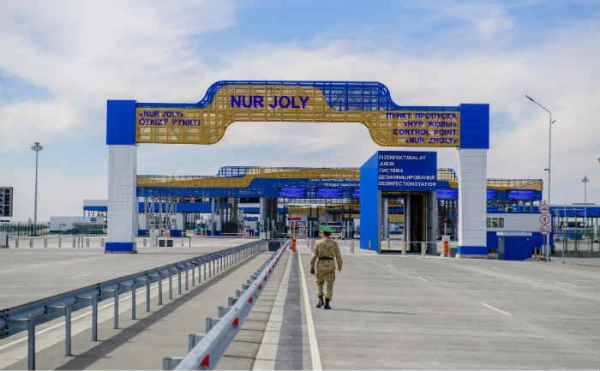
Achieving a trade volume of 106.3 billion USD has become a new record.
China and five Central Asian countries completed 2025 with a record trade volume reaching 106.3 billion USD. According to the General Administration of Customs of China, this is a new historical maximum. This figure has not only statistical but also historical significance, reflecting profound changes in the nature of economic ties between China and Central Asia.
At the beginning of the 21st century, such scales of interaction seemed unlikely. At that time, China had not yet taken its current place in the global economy, and Central Asia, being far from the "ocean of global trade," was perceived mainly as a region with limited involvement in global trade and economic processes. Over the past quarter-century, not only has China transformed from a "world factory" into a complex center of production, investment, technology, and logistics, but Central Asia itself has also changed, especially in the last decade.
The region has consistently strengthened state institutions, developed infrastructure, expanded foreign economic ties, and formed its own regional subjectivity. China and the Central Asian countries have purposefully moved toward each other, building relationships based on respect for sovereignty, pragmatism, and mutual benefit. This reciprocal dynamic has become the foundation of the current level of economic interconnection.
Cooperation within the framework of the Shanghai Cooperation Organization (SCO), and later in the China-Central Asia format, which has gained stable institutional outlines in recent years, has created favorable conditions for trade and investment. Neither the restrictions of the COVID-19 period, nor the slowdown of the global economy, nor serious challenges to the international trading system could become obstacles to achieving record volumes of mutual trade.
The fact that this result was achieved five years ahead of the planned targets is particularly significant. This indicates that behind the numbers lies not a conjunctural surge, but long-term, consistent, and purposeful joint work covering trade, investment, industrial cooperation, transport, energy, and humanitarian exchanges.
The modern structure of trade between China and Central Asia demonstrates a qualitative complication of economic ties. In 2025, China's exports to the region amounted to 71.2 billion USD, an increase of 11%. Its basis consists of machinery and equipment, electromechanical and high-tech products. However, even more indicative is the dynamics of China's imports from Central Asian countries, which reached 35.1 billion USD, showing a growth of 14%. The structure of imports includes agricultural products, energy resources (natural gas and oil), chemical products, steel, and mineral raw materials.
This indicator deserves special attention. Ten years ago, the ratio of exports to imports in China's trade with Central Asia was about 10:1 in favor of China, and the export nomenclature of the region was extremely narrow. Today's data indicate a reduction in structural asymmetry, an expansion of the export base of Central Asian countries, and a gradual formation of a more balanced model of economic complementarity.
The Belt and Road Initiative, proposed in the fall of 2013 in Astana, played a key role in this transformation. Over time, it has evolved from a set of individual infrastructure projects into a powerful structural framework for Eurasian development, which is increasingly perceived as the economic backbone of Eurasia.
Like a backbone that ensures the integrity and stability of an organism, the initiative has linked previously fragmented spaces, establishing sustainable transport, logistics, and production connections between the East and West, North and South. In this structure, Central Asia has ceased to be a peripheral transit corridor and has taken its place as a solid hub through which key economic flows pass.
At the same time, the Belt and Road Initiative has formed a growth artery along which investments, industrial projects, trade routes, and new forms of cooperation have concentrated. It is fundamentally important that the created transport connectivity was not one-sided. Roads, railways, and logistics hubs initially ensured the movement of goods in both directions, expanding access for Central Asian products to the Chinese market and integrating the region into broader Eurasian value-added chains.
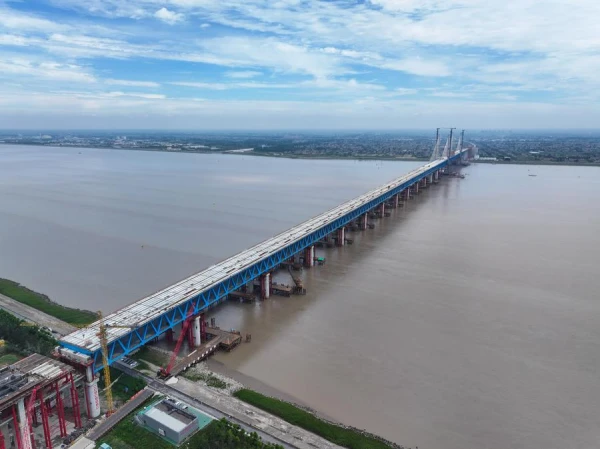
An additional confirmation of the practical logic of the Belt and Road Initiative was the start in December 2024 of the construction of the railway line China – Kyrgyzstan – Uzbekistan, as well as the advancement of the multimodal road corridor China – Tajikistan – Uzbekistan – Turkmenistan – Iran with the prospect of reaching Turkey and European markets. The implementation of these projects significantly expands the transit and transport capabilities of Central Asia, enhances its role in Eurasian logistics, and contributes to the formation of new routes that complement traditional East-West and North-South directions.
In this context, the revival of the Great Silk Road has ceased to be merely a historical metaphor and has acquired a practical dimension. Like in the past, it has once again become a connecting bridge for multilateral trade, technological exchange, and economic development, bringing tangible benefits to all participants.
In the early years of the Belt and Road Initiative's implementation, Central Asian countries (and not only them) faced external skepticism and warnings. In expert and political discussions outside the region, concerns were expressed about possible "debt traps," increasing dependence, and asymmetry of benefits. However, the experience of jointly promoting the initiative has shown that the results of cooperation are largely determined by the effectiveness of national policies and the quality of project implementation, rather than universal evaluative templates. The choice of Central Asian countries in favor of close interaction with China was dictated by a pragmatic assessment of real benefits and long-term development prospects. This was the case at the dawn of the first millennium, and it has also been the case at the dawn of the third.
Against the backdrop of deepening cooperation with China, Central Asian countries are showing a steady interest in developing dialogue with the European Union. In ancient times, the Great Silk Road, which passed through Central Asia, connected China with Europe. The Global Gateway initiative launched in 2021 was perceived in the region as a potential additional source of investment, technology, and sustainable development standards.
At the same time, despite political declarations and announced multi-billion investment packages, the implementation of Global Gateway remains less visible and more stretched over time. This raises doubts about its ability to have a comparable impact on the economic connectivity of the region in the foreseeable future.
In expert and business circles in Central Asia, there are expectations for greater practical returns from the European initiative. For the "Central Asian Five," it is fundamentally important that both initiatives work effectively and towards development goals. Central Asia is increasingly asserting itself as an active participant in global processes, rather than an object of geopolitical rivalry. In this regard, the region is interested in diversifying partnerships and in fair competition, rather than choosing a logic of "either-or."
Achieving a trade volume of 106.3 billion USD between China and Central Asia has become a vivid confirmation of how long-term strategy, consistency, and mutual respect can lead to results that seemed difficult to achieve at the beginning of the century. The Belt and Road Initiative has played a role in this process as a kind of economic backbone and growth artery, profoundly changing the structure of regional connectivity.
At the same time, the development of cooperation with the European Union remains an important element of Central Asia's multi-vector policy.
The potential of Global Gateway is perceived in the region with interest, but also with expectations for more tangible practical steps.
Between the logic of geopolitical rivalry and the logic of joint ascent, Central Asian countries are increasingly confidently choosing the latter, striving to build sustainable, mutually beneficial, and respectful cooperation with all trading partners.







Leave a comment