
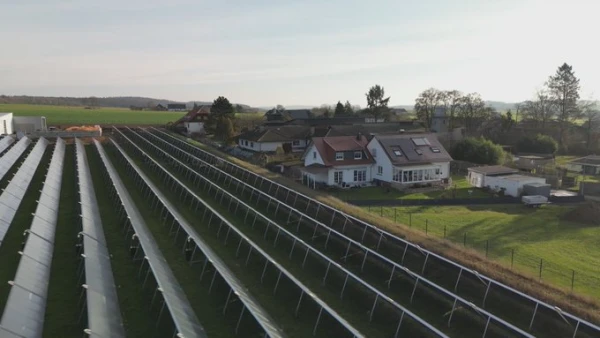
"It’s an incredible feeling — the house is warm, and you’re not burning oil."
The transition to renewable heating in Bracht began not with the government, but with the initiative of the residents themselves. The village is home to about eight hundred people, and it was they who decided to replace traditional oil boilers with eco-friendly heating. The idea originated from a group of active villagers who wanted to make Bracht independent from fluctuations in fuel prices. They created the cooperative Solarwärme Bracht e.G., gathered investments, and took on the organization of a project worth 16.5 million euros.
According to the cooperative's chairman Helgo Schütze, the main task was to convince neighbors to participate, reports zdfheute.de. The team went door to door, explaining the benefits and collecting signatures. Ultimately, enough families joined the project to begin construction.
How the solar heating system works
The heart of the new infrastructure is solar collectors covering an area of 11,640 square meters. In the summer, they heat water to 90 degrees, after which the heat is stored in a huge underground reservoir with a capacity of nearly 27 million liters.
In winter, when temperatures drop, the system is supported by a heat pump that raises the water temperature.
The project is financed from three sources:
-personal contributions from residents;
-European Union grants;
-KfW program — government support for "green" projects.
Each cooperative member contributed 6,000 euros for a share and paid up to 8,000 euros for connecting their house. Part of these costs is compensated.
The price of one kilowatt-hour of heat is 16.5 euro cents — slightly higher than using oil.
However, residents note that they are now independent from the fuel market and know how much they will pay in ten years.
"It’s an incredible feeling — the house is warm, and you’re not burning oil," says Hermann Koch, one of the first participants. Günther Waupel, who previously heated his house with pellets, agrees. He is confident that the project is not only environmentally friendly but also economically sustainable. "The old system was already beyond repair. Now we have warmth and a clear conscience — without CO2 emissions," he adds.
Volunteers, experts, and scientific support
The cooperative's working group has been in existence since 2016. It includes local engineers, architects, and financiers who meet weekly to plan further steps. Much of the work is done voluntarily, significantly reducing costs.
The project is accompanied by Professor Klaus Feijen from the University of Kassel. According to him, the advantage of the Bracht model is the speed of implementation. "A centralized heating system can reduce carbon dioxide emissions by almost 98% literally overnight," notes the professor.
Bracht's experience has sparked interest from other German communities. The village regularly receives inquiries about how to build a similar solar heating system. Local residents are happy to share their developments and calculations, as the project's goal is not only to heat their own homes but also to inspire others.
Thus, Bracht has become a symbol of a successful energy transition from the bottom up. Its example shows that even a small village can become energy-independent if people unite for a common goal.







Leave a comment